
Who moved David to number the Hebrews…“Lord” Jehovah or Satan?
A Contradiction in Scripture?
2Sm:24:1: And again the anger of the Lord was kindled against Israel, and he moved David against them to say, Go, number Israel and Judah.
1Chr:21:1: And Satan stood up against Israel, and provoked David to number Israel.
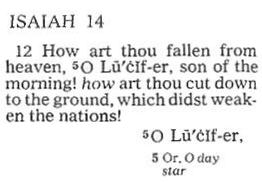
Source: Nelson King James Bible
Footnote states that “Lucifer” simply means “O day star”
Source: The JPS Tnakh
This translation of the Bible does not use “Lucifer” at all, but rather, uses “O shining one, son of the dawn!” and further, footnotes it with “a character in some lost myth”.
Source: NIV. This translation of the Bible does not use “Lucifer” at all, but rather, uses “O morning star, son of the dawn!”
Source: Funk & Wagnalls Encyclopedia
States that Lucifer means phosphorous or “light bearer” and that the early church fathers, made the association to Satan.
Was the Bible the first place where “war in heaven with the dragon” took place?
Rv:12:7: And there was war in heaven: Michael and his angels fought against the dragon; and the dragon fought and his angels, And prevailed not; neither was their place found any more in heaven.
Not according to Archaeology.
Tiamat the dragon and Marduk, “War in Heaven”.
Source: Baker Encyclopedia of the Bible, Vol. 1 “Canaanite Deities”
States that “Helel” is the god found in Isaiah 14:12, referred to as “Lucifer”.
(Isaiah was prophesying against the King of Babylon, not the “Devil”.)
Source: Funk & Wagnalls Encyclopedia:
“One of the most perfect specimens of Babylonian literature is the tablet describing the war in heaven between Merodach and the demon Tiamat…”
Found an interesting thread that I decided to jump into:
More Satan vs. Lucifer
Once again I checked your “source”. Its interesting that in order for you to refute the bible, you rely on antichrist pro-evolutionary websites. You are aware that such sites are a bit biased in their theories.
[…]
✂ ✂ ✂ ✂
[…]
Take care…”
Just wanted you to know youʼre way out of line in your accusations about “unreliable”.
The information, came from:
- The NIV Bible
- The King James Bible
- The JPS Tnakh / Jewish Old Testament (Christian Book Distributors)
- Baker Encyclopedia of the Bible, (which I purchased from Christian Book Distributors)
- Funk and Wagnalls Encyclopedia
Sounds credible enough to me.
It appears your response is based entirely on your personal opinion rather than facts and youʼre in a state of denial.
petersansone wrote:
AndrewWell, occultists could care less for all those sources. Occult means hidden knowledge. If you canʼt understand what this means to your “site”, then there is no point in further explaining it. I canʼt teach all this to you over the internet. It takes years of study.
Take care…
Anyone with any sense is going to take Funk and Wagnalls Encyclopedia, Baker Encyclopedia, the Tnakh, the NIV, the King James, a lot more seriously than your opinions.
You know that could drive a person into insanity always looking for some “hidden meaning between the lines”…the mysteries of the universe on a bubble gum wrapper, eh? For centuries religion lulled the mass population into ignorance with just the superstitious attitude you project.
More on Mysteries and “Hidden Knowledge”
Luther and Calvin agreed that the Bible states the earth does not move, and also that the sun does move:
“He (God) can command the sun not to rise.” (Job 9:7) Rather than, “He can command the earth to stop (moving/spinning).” That God would direct such a command at the sun rather than the earth, implies an unmistakably geocentric perspective. Likewise, Martin Luther pointed out that “Joshua commanded the sun to stand still and not the earth,” since the earth was presumed to be at rest at all times. (Josh. 10:12)
- Martin Luther, Lutherʼs Works. Vol. 1. Lectures on Genesis, ed. Janoslaw Pelikan, Concordia Pub. House, St. Louis, Missouri, 1958, pp. 30, 42, 43.
If God has something to tell me, he better start speaking up and doing so in plain English. I donʼt go for word games and head-games from thousands year old manuscripts written by complete strangers and if you canʼt *get where Iʼm coming from* itʼs a complete waste of my time to explain it to you.
Quote:
It takes years of study.
Which you need to get started on obviously.
BTW, itʼs not Andrew who rejected Funk and Wagnalls Encyclopedia, or JPS Tnakh, or the NIV or King James, or Baker Encyclopedia—it was you who rejected the information, and you posted something above about “Occultists wonʼt accept the information?” Are you an occultist?
Hereʼs more of what you erroneously called “Unreliable” from our site, on superstition:
Our fathers denounced materialism and accounted for all phenomena how? By the caprice of gods and devils. For thousands of years it was believed that ghosts, good ghosts, bad ghosts, benevolent and malevolent, in some mysterious way produced all phenomena; that disease and health, happiness and misery, fortune and misfortunate, peace and war, life and death, success and failure, were but arrows shot by these ghosts or shadowy phantoms, to reward or punish mankind, that they were displeased or please by our actions, that they blessed the earth with harvest or cursed it with famine; that they fed or starved the children of men; that they crowned or uncrowned kings; that they controlled war; that they gave prosperous voyages, allowing the brave mariner to meet his wife and children inside the harbor bar, or strewed the sad shore with wrecks of ships and the bodies of men. Formerly these ghosts were believed to be almost innumerable. Earth, air and water were filled with the phantoms, but in modern times they have greatly decreased in number, because the second proposition that I stated, the supernatural and the natural, has generally been adopted, but the remaining ghosts are supposed to perform the same functions as of yore.
In order to show you the information we got from the ghosts, and the condition of the world when the ghosts were the kings, let me call your attention to this: During these years of persecution, ignorance, superstition and slavery, nearly all the people, the kings, lawyers and doctors, learned and unlearned, believed in that frightful production of ignorance, of fear and faith, called witchcraft. Witchcraft to-day is religion carried out. They believed that man was the sport and prey of devils; that the very air was thick with these enemies of man, and, with few exceptions, this hideous progress was almost impossible. Fear paralyzed the brain.
Progress is born of courage. Fear believes, courage doubts. Fear falls upon the earth and prays; courage stands erect and thinks. Fear retreats; courage advances. Fear is barbarism; courage is civilization. Fear believes in witchcraft; courage in science and eternal law.
The whole world appeared insane. In the time of James I. a man was burned for causing a storm at sea, with the intention of drowning one of the royal family; but I do not think it would have been much of a crime if he had been really guilty. How could he disprove it? How could he show that he did not cause a storm at sea? All storms were at that time supposed to be inspired by the devil; the people believed that all storms were caused by him, or by persons whom he assisted. I implore you to remember that the men who believed these things wrote our creeds and our confessions of faith, and it is by their dust that I am asked to kneel and pay implicit homage, instead of investigating; and I implore you to recollect that they wrote our creeds.
A woman was tried and convicted before Sir Matthew Hale, one of the greatest judges and lawyers of England, for having caused children to vomit crooked pins. Think of that! The learned judge charged the intelligent jury that there was no doubt as to the existence of witches; that it was established by all history and expressly taught by the Bible. The woman was hung and her body was burned. Sir Thomas More declared that to give up witchcraft was to throw away the sacred Scriptures. John Wesley, too, was a firm believer in ghosts and, insisted upon their existence after all laws upon the subject had been repealed in England, and I beg of you to remember that John Wesley was the founder of the Methodist Church. In New England a woman was charged with being a witch and with having changed herself into a fox; while in that condition she was attacked and bitten by some dogs, and a committee of three men was ordered by the Court to examine this woman. They removed her clothing, and searched for what they were pleased to call witch-spots—that is to say, spots into which a needle could be thrust without giving pain; they reported to the Court that such spots were found. She denied that she had ever changed herself into a fox. On the report of the committee she was found guilty, and she was actually executed by our Puritan fathers, the gentlemen who braved the danger of the deep for the sake of worshipping God and persecuting their fellow men. I belong to their blood, and the best thing I can say about them, and what rises like a white shaft to their eternal honor, is that they were in favor of education.
A man was attacked by a wolf; he defended himself and succeeded in cutting off one of the animalʼs paws, and the wolf ran away; he put it in his pocket and carried it home; there he found his wife with one of her hands gone, and he took that paw from his pocket and put it upon her arm, and it assumed the appearance of a human hand, and he charged his wife with being a witch. She was tried, she confessed her guilt, and she was hung and her body was burned!
“Ghosts” by Robert G. Ingersoll
IMAGINE THAT. Thatʼs what looking for “hidden things” will lead society into—in other words, looking for whatʼs not there nine times out of ten.
Better to stick with reason, science and common sense.
petersansone wrote:
Everything in my post stands. You were incorrect in your commentary on Rev 12. Your position on Lucifer is also incorrect and though I am not a practicing pagan/occultist, I do know what occultists know since I have read from primary source books. You clearly do not understand the occult because your information on them does exactly what occultists want, it leads casual seekers away from hidden truth. I told you that the word occult means hidden knowledge. There is no time to teach you the basic truths of occult/gnosticism. I donʼt have the time to clean up your errors but to say that your site is wrong on most of its material. A true adept in the occult would laugh at your quotations of Funk and Wagner etc….…
Helllllllllooooo …is anyone home there?
I donʼt give a flipping @# what occultists believe. I do however care what historians, theologians, scholars, scientist says. You obviously do not. Youʼre calling fact fiction, and fiction fact. You made the assertion that the sources we cited from mainstream encyclopedias, encyclopedias authored by scholars, Bibles translated by scholars were unreliable and the information from them is “incorrect”.
What planet do you come from?
Quote:
Occult means hidden knowledge.
What does that have to do with anything?
WHO CARES? Total Non Sequitur. The sources we cited are legitimate and there was no “hidden agenda” as you accused however, because the page Andrew posted did not say what you wanted it to, you posted a lengthy string of insults and outright lies about the page. The facts stand on their own and no matter if Occultists believe the moon is made of green cheese wonʼt make it so. If you want to know what the moon is composed of, ask an astronomer not an “Occultist”.
FALLACY #1 NON SEQUITUR
An inference or conclusion that does not follow from the premises or evidence.
A statement that does not follow logically from what preceded it.
Itʼs based on facts from mainstream authorities yet youʼd try to make people believe the information is (in your own words) incorrect and biased…that is an Ad Hominem attack.
FALLACY #2 AD HOMINEM
Appealing to personal considerations rather than to logic or reason: Debaters should avoid ad hominem arguments that question their opponentsʼ motives.
Usage Note: As the principal meaning of the preposition ad suggests, the homo of ad hominem was originally the person to whom an argument was addressed, not its subject. The phrase denoted an argument designed to appeal to the listenerʼs emotions rather than to reason…
The phrase now chiefly describes an argument based on the failings of an adversary rather than on the merits of the case…
The expression now also has a looser use in referring to any personal attack, whether or not it is part of an argument…
Ad hominem has also recently acquired a use as a noun denoting personal attacks…
Whether or not you like “AntiChristian ProEvolutionists” is totally indifferent to the facts presented on that page.
Quote:
Occult means hidden knowledge.
Hereʼs some “hidden meanings” for you:
IS “SANTA” JUST “SATAN” MISSPELLED?
I once heard an Evangelist warn, “Santa is just Satan misspelled!” If thatʼs true then maybe “Evangelist” is just “Evilʼs Agent” misspelled? And maybe, “Fundamentalist Christian” is “Filthier Mad Cunts in Satan” misspelled?
- Source unknown
Further Misspellings
Maybe “God Bless America” is “Assbead micro gel” misspelled?
Maybe “House of Worship” is “Whore of his opus,” or, “Whore sushi poof” misspelled?
Maybe “Christian Fellowship” is “Lisa, his elf porn witch,” or, “Elf porn with ass chili,” misspelled?
Maybe “Assembly of God” is “Bloody fag mess,” misspelled?
Maybe “Praise Jesus” is “Jesus is rape,” misspelled?
Maybe “Pensacola Christian College” is “Gil selects a choice anal porn,” misspelled?
— D. Boyd
petersansone wrote:
Everything in my post stands.
Everything youʼre saying falls flat on its face when put under scrutiny.
petersansone wrote:
A true adept in the occult would laugh at your quotations of Funk and Wagner etc….…
Who cares what a minority of self-deluded occultists think?
Hereʼs what Andrew stated, and what youʼre saying has nothing to do with the points he brought up:
Andrew: Lucifer-the light bearer.Its intresting to note that the ancient Jews didnt have a lucifer or satan conscept.That was adapted later through cultrual minglings of other beliefs.Satan seems to be an entirely differant dude then lucifer though the christion religion morghed those two seperate consepts together.The talking snake in the garden of eden in pagan religions was a fertality symbol and the symbol of immortality.Snakes shed there skin and the ancients thought the old skin was the original dead snake and the new one was a entirely born agian snake.Since this was a fertality symbol and the symbol of immortality,it is no surprise this snake was by the tree of life and the tree of knowledge of good and evil.This pagan deity got incorporated into Babolonian mythology wich the hebrews incorporated into the Torah.
What an occultist does or does not believe is indifferent to the point of Andrewʼs post. Here is something thatʼs of relevance:
Acts:23:8: For the Sadducees say that there is no resurrection, neither angel, nor spirit: but the Pharisees confess both. (KJV)
Why didnʼt the Sadducees believe in Angels or an afterlife? Because these were foreign concepts which slowly integrated themselves into ancient Jewish religion.
Content of the Apocrypha
“For a greater understanding of the history of Judaism and Christianity, these books are well worth studying. The Apocrypha illuminates Jewish thought during the years between the close of the Old Testament and the beginning of the New Testament. Many concepts that are taken for granted in the New Testament are hardly mentioned in the Old Testament, such as angels and demons, as well as reward and punishment in the afterlife.”
Source: The Missing Books of the Bible, Volume One, p. 8
Ottenheimer Publishers, 1996
Purchased from Christian Book Distributors
As noted on the page you were so vehemently discrediting as “biased”, hereʼs a small fact that was stated on it:
1Chr:21:1: And Satan stood up against Israel, and provoked David to number Israel.(KJV) is the first time the word “Satan” appears in the Old Testament. The parallel account of Davidʼs numbering Israel (same account, different book)
2Sm:24:1: And again the anger of the Lord was kindled against Israel, and he moved David against them to say, Go, number Israel and Judah. (KJV) So, who moved David to number Israel? Satan or the Lord?
The word “Satan” does not even appear until the end of the Old Testament because it was not a concept which the early Hebrews believed in.
The Hebrews believed “The Lord” was the giver of evil:
Is:45:7: I form the light, and create darkness: I make peace, and create evil: I the Lord do all these things. (KJV)
Not one mention of Satan.
Hereʼs more on the reliability of these “concepts” found in ancient texts:
Jude:1:14: And Enoch also, the seventh from Adam, prophesied of these, saying, Behold, the Lord cometh with ten thousands of his saints,
[Jude is speaking of the book of Enoch]
Jude:1:6: And the angels which kept not their first estate, but left their own habitation, he hath reserved in everlasting chains under darkness unto the judgment of the great day. (KJV)
That is no other than the old myth of the Titans who were cast down and bound in Tartarus, “The lowest hell”.
Reference: Topical Study on ‘Tartarus’ (Forerunner Commentary) :: Bible Tools …In Greek mythology, Tartarus was the lowest hell, the place where the Titans (who rebelled …To add to the imagery, they are bound in “chains of darkness…
Think “Revelation and the Bottomless Pit”.
And what do scholars think of the “Book of Enoch”?
Well, we know it doesnʼt appear anywhere in any mainstream Bible.
Why is that?
What Was the Purpose of the Scape Goat?
[…] “In later Jewish theology, the apocryphal book of Enoch uses Azazel as the name for one of the fallen angels. But there is no evidence for the existence of a demon by that name in Mosesʼ day. Enochʼs elaborate demonology is admittedly late (c. 200 B.C.) and often uses the late aramaic forms for these names. It is clear that they are all of postbiblical invention.
Source: Hard Sayings of the Bible, (c)1996 Intervarsity Press, p. 159
Why did Jude [a book found in the New Testament] quote from a fraudulent text which some tried to pass itself off as writings of Adamʼs seventh son?
Andrewʼs point was well made. Mythical concepts crept into ancient Jewish theology.
petersansone wrote: etw-
You may disregard the occult but noted writers on history such as Nesta Webster document that occult groups have had a tremendous impact on history. Example: The Jacobins aka masons/jesuits were responsible for instigating the French Revolution. But lets leave the occult out of this since its to vast and complicated to go into.
So have a lot of things. Does that make any of the citations Iʼve given “incorrect”?
You stated that the Ancient Hebrews had no concept of Satan/Lucifer. And yet Satan is recorded in the OT several times. As I noted, the Septuagint which was written by rabbinic scholars in 250bc notes the Satanic references in Chronicles, Job, and Zechariah as “the Devil”. Clearly then, the concept of Satan was established in antiquity.
From “‘Curse on the Serpent’ in Genesis Bites the Dust”
“While Iʼm discussing the tale of the poor cursed serpent, I should add that there isnʼt the slightest evidence that the “serpent” had any connection with “Satan.” Thatʼs a later Christian invention. “Satan” is not even mentioned in the whole book of Genesis, not when Cain kills Abel, nor when the “whole world” turns away from God prior to “the Flood,” nor at “the tower of Babel” incident, which also “displeased” God. No mention of “Satan” anywhere. (Of course regardless of the fact that Genesis nowhere mentions “Satan,” Christian apologists still have no trouble finding “Satan” wherever and whenever they need to. In fact they find “Satan” lurking behind everything going on in the world today, and of course also find him hiding inside that serpent mentioned in Genesis, except they do not want to take seriously every verse concerning that serpent, namely that “Satan” was “craftier than any beast of the field which the Lord God had made,” and “Satan,” was “cursed more than any beast of the field, more than all cattle…to go upon his belly and eat dust all the days of his life.”
Itʼs plain to see there is no mention of “Satan” in the original Hebrew fable***, just a “crafty talking serpent,” whom Yahweh curses by washing its mouth out with dirt for the rest of its life - a fable in the most Aesopian sense of the word.
***And why indeed, with an event of such incredibly monumental significance as the “war in heaven” between God and the fallen angels (that Milton wrote of so eloquently), why did neither the authors of the creation stories, nor later editors of Genesis think to mention such a “war” even though they were allegedly inspired by God to write their “Godʼs eye view” of “the beginning” of all things. Neither did the author of Job (with his “Godʼs eye view” of matters) in which he saw “Satan” entering Godʼs holy court unmolested, mention any such “war.” Satan back then was just Godʼs chief accuser, a sort of heavenly D.A.
Even the earliest reference in the Bible to a fall of “Lucifer” isnʼt speaking of Satan, but the word “Lucifer” was a loan word referring to an ancient god of a rival culture. Only after a period of centuries in the development of Hebrew religious conceptions did people start talking about “Satanʼs” “fall from heaven,” and make him “prince of this world,” “prince of the power of the air,” etc. In fact, the intertestamental Book of Enoch is the first to eloquently explain “Satanʼs” “fall from heaven,” before even the N.T. mentioned such a thing. (The Book of Enoch also explained other things as well, to the great embarrassment of whomever connected the name of a revered Biblical patriarch with a collection of utter nonsense. Oh, and the Book of Enoch and Judeʼs endorsement of a direct quotation from it, attributing it to “Enoch, the seventh from Adam,” is yet another source of embarrassment for “Bible believers.” Itʼs interesting that the intertestamental Book of Jubilees circa, 200 B.C. was the first to mention the biblical patriarch “Enoch” as a writer of many books, and soon after that or perhaps contemporaneously with that, the earliest writings attributed to “Enoch, the seventh from Adam” began appearing, various portions of them dated anywhere from 150 B.C. to the late first century A.D., and later collected into what is now known as 1st Enoch.)
Serpent figures were common in the ancient world, and the description in Genesis of the serpent being stepped on and biting the heel of the seed of woman is merely a generic description of conflict. Hardly proof of anything. Consider Genesis, chapter 49 when Jacob blesses his children before his death, part of his blessing to Dan in verse 17 is: “May Dan be a snake beside the road, a viper by the path, that bites the heels of the horse so that its rider falls backward,” (NET Bible). The generic term for serpent, “nahash,” is used here (just as in Genesis when the “nahash” spoke to Eve). Most commentators believe that the serpent image in this passage is positive since this is a blessing. Dan, though a small tribe, will be as shrewd as a serpent, able to bite its enemiesʼ heels so that they are defeated.
[NET Bible, 131, note no. 6; Sailhamer, 278; Henry, 92; The Wycliffe Bible Commentary, 46; H. C. Leupold, Leupold on the Old Testament. Vol. 2, Exposition of Genesis (Grand Rapids: Baker Book House and The Wartburg Press, 1942), 1188-1189]
In the story of Eveʼs temptation, the generic term for “serpent” is used, a “nahash.” And that generic serpent is merely described as being “crafty,” the Hebrew word being “arum,” a word which is not necessarily negative, but suggests wisdom and adroitness, or being shrewd or clever.
[The Wycliffe Bible Commentary, 6-7; John H. Sailhamer, “Genesis,” in The Expositorʼs Bible Commentary, vol. 2, ed. Frank E. Gaebelein (Grand Rapids: The Zondervan Corporation, 1990), 50]
A Failed Prophecy!
The Serpent to eat dust in Genesis?
…]
The Serpent to eat dust in a coming kingdom prophecied by Isaiah?
huh?
Canʼt be both, now can it?
“And the Lord God said to the serpent, ‘Because you have done this, cursed are you more than all cattle and more than every beast of the field; on your belly shall you go, and dust shall you eat all the days of your life.’” (Gen. 3:14)
Final bonus question: Compare the way Isaiah employed a very similar phrase to the one found in Genesis: “The wolf and the lamb shall feed together, and the lion shall eat straw like the bullock: and DUST SHALL BE THE SERPENTʼs MEAT. They shall not hurt nor destroy in all my holy mountain, saith the Lord.” Isa. 65:25 (KJV)
In this verse the “dust” the serpent eats is its literal “meat,” and not a metaphor at all. Though I wonder by what miracle a serpent or snake will be able to eat “dust” as its “meat.” That sounds more like an earthworm than a serpent or snake. So the serpent does finally “eat dust,” and in quite a literal fashion, but only in the coming kingdom. Amazing how one Scripture writer built on anotherʼs use of a phrase, but in a way in which one Scripture writer so twists anotherʼs earlier words that you wind up being reminded of the head twisting scene in THE EXORCIST.
“petersansone” wrote: In addition the Dictionary of Judaism notes the following on Satan:
“Satan (from the Heb noun meaning adversary) a member of the heavenly court whose primary adversarial function is to accuse in legal disputes. The Noun usually appears with the definite article, indicating a role rather then a personal name. In Zechariah 3 he and the angel of Yahweh dispute Joshuaʼs fitness for the high priesthood. In Job 1-2 accusation leads to testing”….etc.
A PERSIAN INVENTION
Glossary
…in Job and Zechariah, or whether the ‘adversary’ is to …the development of the idea of Satan that is …Probably under the influence of Persian ideology, there …
Satan (Greek: Satan or Satanas) as used in the New Testament is a word of Hebrew origin. It means the accuser, the adversary, the opponent, the prosecution (in a legal case). In the Greek New Testament the Hebrew word Satan is often translated into the Greek word diabolos, which most commonly is translated into English as Devil. Diabolos means the accuser, slanderer, calumniator, backbiter, enemy, one who separates.
It is during the late postexilic period (after ca. 200 b.c.) and in the intertestamental literature that one first finds the development of the idea of Satan that is assumed in the nt writings. Probably under the influence of Persian ideology, there developed in Hebrew thought the idea of a dualism rampant in the created order—a dualism of good versus evil. There existed already the idea that God had a heavenly host, a group of messengers to carry out his work and orders. The Persians also believed in a ruler over the powers of evil, who had many servants in this realm known as demons. The Hebrews could easily understand and assimilate such thinking into their already existing ideas, but they had not yet developed any idea of a major being as a leader of the forces of evil. Thus, in the development of the religious thinking of the Jewish people, several different names were used to designate the leader of those forces hostile to God: the devil, Belial (also Beliar), Mastemah, Apollyon (meaning the ‘Destroyer’), Sammael, Asmodeus, or Beelzebub. Satan, however, came to be the most usual designation (in Greek, Satan was translated as ‘the devil’). Another interesting development took place during this period: the figure of the devil or Satan came to be identified with ‘the serpent’ of Genesis 3.
Try this link too:
The Bible for Dummies
Surprisingly, most of what people believe about Satan does not come from the Bible. For instance, the common image of Satan as a forked-tailed horned demon with a goatʼs body from the waist down derives more from the Greek god Pan than anything biblical. What, then, does the Bible say about Satan?
The Hebrew name Satan (pronounced sa-tan) actually means “adversary,” and most often in the Hebrew Bible it is prefaced by the direct object, meaning “the adversary” rather than a distinct personal name. Satanʼs role grows more developed both in scope and magnitude through time, and, thus, in the earlier writings of the Hebrew Bible, Satan exists not so much as an individual character but as an adversarial position occupied by both humans and angels.
[…]
Many scholars attribute Satanʼs development from an adversary to the archenemy of God to the influence of the Persian religion Zoroastrianism. This religion is a lot like Star Wars, in which two opposing forces, one good and the other evil, struggle for control of the universe. Yet, the New Testament preserves the Hebrew Bibleʼs notion of Satan as far inferior to God and needing to get Godʼs permission before “raising hell” on earth (see, for example, Luke 22:31). Following the biblical period, Medieval theologians reinterpreted passages such as Isaiah 14 and Ezekiel 28, in which Babylonian and Phoenician kings are condemned for pride, as descriptions about Satan. In fact, the name Lucifer comes from a Latin translation of Isaiah 14:12, in which the Babylonian king is linked to a fallen Morning Star, called in Latin lucern ferre (“bearer of light”).
Therefore Judaism does acknowledge the reality of Satan in the scriptures as well as upholding the christian position that Satan is the accuser of Gods people.
See above.
You noted that the Sadducces where not in favor of the afterlife and spirit world. Yet you never bothered to note the truth that the Phariseeʼs were in favor of these concepts. This shows that not all of Israel was against the spirit world. The Pharisee were also far more in number then the Sadducces and more versed in scripture.
It goes to prove the concept was spreading in Hebrew religion. Havenʼt you ever heard of “Lilith”, Adamʼs first wife? Rabbinic lore had it that Eve was made his second wife, and the scorned Lilith fled. Later she was reinvented into a succubus and became a demon which attacked newborn babies because she never had one. Myths evolve like that.
You also quoted from the book of Enoch and questioned why this apocraphyl book was not included in the canon of scripture. Jude quotes from this book but only one passage which was permissible to be included in the Canon of scripture. Paul also quoted in Acts from the gentile poet but that does not mean that this poetʼs writings were scripture. It was permissible to include quotations from selected writings which were conducive to put forth the point which the Word of God was making.
Is it permissible to quote from the Satanic Bible in Church? Afterall, the concept of Satan appears in the Bible, therefore theyʼre one in the same (at least thatʼs your reasoning.) Itʼs likewise acceptable to preach from the Q’ran, it too acknowledges Abraham and Isaac and Jacob and even mentions Jesus.
This does not entail that the entire body of material from which the quote was taken should also be included in scripture. The fact is the Hebrews were responsible for maintaining their own scriptures which they did meticulously. Apocryphal books may contain some truths or even entire bodies of truth, but still are not considered to be the Word of God or Divine revelation. This decision was made by the Jewish an christian scholars via councils. The Holy Spiritʼs role included.
Incidently, the New Testament was completely written by Jews/Israelites. Jesus Himself was a Jew. Paul was an extremely well qualified Pharisee who trained under Gamaliel. All of these Jewish men quoted passages form the Old Testament affirming the christian doctrines of the faith such as Lucifers fall from grace, his becoming Satan. The reality of the fall of angels and their co-habitation with women in Gen 6. The eventual ruin of Satan and casting into the Lake of Fire. Eternal punishment etc. The early church fathers also have reinforced these teachings on Satan, Lucifer, Hell etc such as Mathetes epistle to Diognetus Ch. 10; Polycarp epistle to the Philippians Ch. 7; Ignatius to the Ephesians Ch. 19; Ignatius to the Magnesians Ch.5; Ignatius epistle to the Philadelphians Ch. 3; Ignatius epistle to the Smyrnaeons Ch. 7 (directly connects serpent of Genesis 3 with Satan of Zech 3); The epistle of Barnabas Ch. 18; First Apology of Justin Martyr Ch. 8,10, 19, 25, 26, 28, 40,44, 45, 47.
These passages affirm that such notions of the spirit world were not merely christian inventions since the early church was mostly Jewish. The fact is the NT is a Jewish document with the exception of Lukes books. Anyone who claims that Jews did not believe in the concept of Lucifer/Satan etc is not maintaining honest scholarship. The temptation to deny Jews their heritage simply because they believed that Jesus was the fulfillment of ancient Jewish messianic prophecy smacks of bias.
Finally, it should be noted that even though some Jews may not have believed in the concept of Satan/Lucifer, the Jews have proven that they struggled with many of their own teachings as evidenced by the historical fact that they were deported out of their land twice in 700b.c. by the Assyrians and in 586 b.c. by the Babylonians. The bible states these punishments were for disobedience to their God and His Word. Should we then take their stance on scripture as certifiable fact? This last point I mention hypothetically…
Take care…
I donʼt care much for creeds, dogma and interpretations. You know what they say about opinions and @holes—“Everyone has one”
Christian Meta-groups
…of a group of independent denominations, sects, and independent churches numbering in excess of 30,000 worldwide. …of almost a hundred denominations, of which…
Yet nearly every single one of those thirty thousand likely believe they hold the monopoly on the “one and only truth”.
BALAAMʼs ASS: Were You the Unchurched?
…And so I became a proto-Christian. Which opened yet another question: which one of these 40,000 Christian sects and denominations is the “true” Church?…
See more by Googling.
petersansone wrote: etw-
You disregarded my points which where based on sound accepted theological documentation. You searched and produced websites that match your opinions. Thats your right.
Thatʼs not exactly fair. I form my “opinions” based on sound research.
You also mentioned religions such as zoroastrianism which goes into the occult situation I mentioned before. You might not think that religions are the occult but occultists such as Crowley, Pike, and Blavatsky disagree with you and they are founders and experts on the occult and its mystery religions. You donʼt understand the nature of this situation which includes all religions against The Holy Bible and its True God. Unsaved people really cannot understand these spritual things. You may not realize this, but much of what you have noted on Lucifer comes from the occult. You do not understand the occult not do you understand where and when it emerged. I could not get you caught up on this point. To bad you never attended classes where I taught on this subject. Let me cut to the bottom line however.We can argue these points forever but they are really not the issue. The issue is you do not believe in God
But I do not need to believe in the Bible to hold a belief in God. ;)
Actually I am a Deist, (Sharon) Edʼs Webmaster (etb for edwardtbabinski) wm for webmaster. :)
Even Ed is an Agnostic and not an Atheist. We both have healthy skepticism on a lot of issues, the Bible being only one of them.
and therefore you disregard the scriptures from Genesis to Revelation. I, on the other hand, believe in God, am a born again christian, and have placed my soul in the hands of Yahweh and His Son Yeshua. You continue on your path and Iʼll continue on mine. Thank you for the discussion. Bye now…
Ditto, thoroughly enjoyed the stimulating conversation with you!
Returned on February 11, 2005 and picked up on more conversation:
“Stevie K”petersanone wrote:Your site claims, as you do, that Lucifer is a pagan myth such as Venus etc. Indeed Lucifer means light bearer. Lucifer is the chief god of the pagans/mystery religions which one can find out by reading the masonic bible where the author Albert Pike points this out. You may even want to read that book though its over 700 pages long. I have it and it is very interesting. Anyways, Lucifer is also known as Venus, Sirius, Zeus, etc. All these terms are meant to point to the pagan belief that Lucifer provides the light and hidden knowledge of mans true deity and ultimate godhood. This is the secret of the mystery religions so consider yourself initiated into the mystery of the mystery religions and free of charge at that. Top level occultists also believe that Lucifer is the true God and not Yahweh. Only a person who has put in the time and effort to read the primary occult source books will know this truth. Have you?Lucifer in no way is harmonious with Zeus, Venus, etc. nor any other of the Greco/Roman gods as you claim save maybe Apollo, Pan, and Bacchus. But he has nothing to do with the other principal Gods nor their worship. This is extreme misinformation and Iʼm sure if that book was written by anyone of even slight knowledge of popular religion of the time they made no such claims and you are merely misquoting them to back your own argument. Iʼm sure someone else in this thread has already addressed this, but I was too lazy to search for it.
Lucifer is the Latin name for the first star seen in the morning, the morning star, and has little to do with actual light or enlightenment. He merely signals the coming of Apolloʼs chariots (the Sun). Thus the term light bearer. Nothing more nothing less. However, Apollo is associated with knowledge and understanding as well as the arts and many other things of the sort that most people attribute to Lucifer, which is a huge misconception.
Hereʼs what Google turned up: Latin Vulgate Jerome Lucifer
The Name “Lucifer"
…Hebrew word “heylel” is used and Jerome translated this into Latin s “lucifer”! …But in the Latin Vulgate translation of Jerome it appears twice!…
Lucifer - where did the word come from and what is its true meaning?
…How did the translation “lucifer” arise? This word comes from Jeromeʼs Latin Vulgate. Was Jerome in error? Not at all. In Latin at the time,…
The answer was a surprise. In the original Hebrew text, the fourteenth chapter of Isaiah is not about a fallen angel, but about a fallen Babylonian king, who during his lifetime had persecuted the children of Israel. It contains no mention of Satan, either by name or reference. The Hebrew scholar could only speculate that some early Christian scribes, writing in the Latin tongue used by the Church, had decided for themselves that they wanted the story to be about a fallen angel, a creature not even mentioned in the original Hebrew text, and to whom they gave the name “Lucifer.”
Why Lucifer? In Roman astronomy, Lucifer was the name given to the morning star (the star we now know by another Roman name, Venus). The morning star appears in the heavens just before dawn, heralding the rising sun. The name derives from the Latin term lucem ferre, bringer, or bearer, of light.” In the Hebrew text the expression used to describe the Babylonian king before his death is Helal, son of Shahar, which can best be translated as “Day star, son of the Dawn.” The name evokes the golden glitter of a proud kingʼs dress and court (much as his personal splendor earned for King Louis XIV of France the appellation, “The Sun King”).
The scholars authorized by …King James I to translate the Bible into current English did not use the original Hebrew texts, but used versions translated …largely by St. Jerome in the fourth century. Jerome had mistranslated the Hebraic metaphor, “Day star, son of the Dawn,” as “Lucifer,” and over the centuries a metamorphosis took place. Lucifer the morning star became a disobedient angel, cast out of heaven to rule eternally in hell. Theologians, writers, and poets interwove the myth with the doctrine of the Fall, and in Christian tradition Lucifer is now the same as Satan, the Devil, and—ironically—the Prince of Darkness.
So “Lucifer” is nothing more than an ancient Latin name for the morning star, the bringer of light. That can be confusing for Christians who identify Christ himself as the morning star, a term used as a central theme in many Christian sermons. Jesus refers to himself as the morning star in Revelation 22:16: “I Jesus have sent mine angel to testify unto you these things in the churches. I am the root and the offspring of David, and the bright and morning star.”
Is Satan “Lucifer”?
…from Jeromeʼs translation of the Bible (AD 383-405) known as the Latin Vulgate. Jerome, likely believing that the term was describing the planet Venus,…
Who Is Lucifer? : Christian Courier
…The term “Lucifer” was taken by the King James Version translators from Jeromeʼs Latin Vulgate (383-405 AD) edition of the Bible.
The word “Lucifer” never appeared in the Bible until Jerome translated the scriptures into the Vulgate (Latin Bible) and used the term meaning “phosphorous or light bearer”. After doing so, the early Christians made the association between “Lucifer” and “Satan”. Funny how one myth takes root on another and grows like that. Since that time Satan and Lucifer have been one in the same. But petersanone, it was not so during the time Isaiah was written. Isaiah was addressing the King of Babylon, prophecying of his demise. Isaiah 14:12 has nothing to do with a mythical dragon or devil. Isaiah draws the comparison (poetically) between the King of Babylon and the god Helel who like Venus was a morning star. You see people in those days did not have any extensive knowledge of Astronomy—Astrology is not Astronomy and still to this day we have Greek myths painted in the heavens. Ancient man believed stars in heaven were “gods” and today we know better…stars can be a number of things, including distant suns—but they are not gods.
Read what Isaiah says in context:
Is:14:12: How art thou fallen from heaven, O Lucifer, son of the morning! how art thou cut down to the ground, which didst weaken the nations!
Isaiah speaking with a certain amount of sarcasm, comparing the King to a god
Is:14:15: Yet thou shalt be brought down to hell, to the sides of the pit.
Is:14:16: They that see thee shall narrowly look upon thee, and consider thee, saying, Is this the man that made the earth to tremble, that did shake kingdoms;
Is Satan a man?
Is:14:17: That made the world as a wilderness, and destroyed the cities thereof; that opened not the house of his prisoners?
Is Satan a charity?
Is:14:19: But thou art cast out of thy grave like an abominable branch, and as the raiment of those that are slain, thrust through with a sword, that go down to the stones of the pit; as a carcase trodden under feet.
More of Isaiahʼs distaste of the Babylonian King
Is:14:20: Thou shalt not be joined with them in burial, because thou hast destroyed thy land, and slain thy people: the seed of evildoers shall never be renowned.
Satan had “people” to him?
Is:14:22:For I will rise up against them, saith the Lord of hosts, and cut off from Babylon the name, and remnant, and son, and nephew, saith the Lord. Needless to say, the prophecy against the King of Babylon followed by prophecies against Babylonʼs neighbor, Assyria: Is:14:25: That I will break the Assyrian in my land, and upon my mountains tread him under foot: then shall his yoke depart from off them, and his burden depart from off their shoulders.
“petersanone” wrote:Lucifer is the chief god of the pagans/mystery religions which one can find out by reading the masonic bible where the author Albert Pike points this out. You may even want to read that book though its over 700 pages long. I have it and it is very interesting. Anyways, Lucifer is also known as Venus, Sirius, Zeus, etc. All these terms are meant to point to the pagan belief that Lucifer provides the light and hidden knowledge of mans true deity and ultimate godhood. This is the secret of the mystery religions so consider yourself initiated into the mystery of the mystery religions and free of charge at that. Top level occultists also believe that Lucifer is the true God and not Yahweh. Only a person who has put in the time and effort to read the primary occult source books will know this truth. Have you?
Prior post points out “Lucifer” was merely a word Jerome picked out to use in place of “Morning Star” or a Canaanite desert god named Helel. [Just an old forgotten character in a long forgotten myth.]
Isaiah 14:12 has nothing to do with a mythical dragon or devil. Isaiah draws the comparison (poetically) between the King of Babylon and the god Helel who like Venus was a morning star. You see people in those days did not have any extensive knowledge of Astronomy—Astrology is not Astronomy and still to this day we have Greek myths painted in the heavens. Ancient man believed stars in heaven were “gods” and today we know better…stars can be a number of things, including distant suns—but they are not gods.
Is:14:12: How art thou fallen from heaven, O Lucifer (morning star), son of the morning! how art thou cut down to the ground, which didst weaken the nations! (KJV)
Imagine that!
The planet Venus falling on the earth. It couldnʼt even “fall” petersanone—falling depends on gravity. Venus has its own gravity. All matter has gravity. Although hypothetically if Venus changed its orbit (though highly unlikely) Earth and Venus could “collide” but that would not qualify as “venus falling to earth”. People at that time in history, believed the earth was flat, on fixed foundations and a bowl or dome (modeled after the Egyptian sky god nut in some depictions) lay over the earth from horizon to horizon. Up within this heavenly “dome” resided the gods. So “gods” or “stars” could fall or be cast down to earth by wars in heaven.
Rv:9:1: And the fifth angel sounded, and I saw a star fall from heaven unto the earth: and to him was given the key of the bottomless pit. (KJV)
We know better than that today…stars are not gods. Stars do not “fall from heaven”. Meteorites may cross paths with the earthʼs orbit, enter our atmosphere and burning up and in the ignorant view of ancient man the tiny lights in the sky (suns, moons, planets, comets, etc) appeared to be approximately the same size of a meteorite when it entered the earthʼs atmosphere.
A sun falling on the earth. 
Surfing for Sunbeams: The Sun is a Star
Our Sun is A Star. The Sun is a star. This is a basic fact which is very often overlooked. The Sun is such a familiar object in the…
Ask Dr. Elliot - Our sun IS a star PHYSICS & ASTRONOMY…Our sun IS a star.
NASA - A Star Is a Big Ball of Gas
…Credit: NASA A star is born in a nebula. A nebula is a cloud of gas and dust in space. Our Sun is a star. It is a yellow star. (But donʼt look straight at it.…
This is not a matter of mystery anymore. It is a matter of common sense. If a star fell on the earth, all earthlings would be toast.
These are not hidden mysteries, they are simply ignorance of ancient man. Weʼve came a long way since then.