

In my email to Chris Sharp (directly follows this one) I mentioned difficulties I had with the atonement concept.
Another related biblical idea also doesnʼt seem to add up, not from what Iʼve read about it.
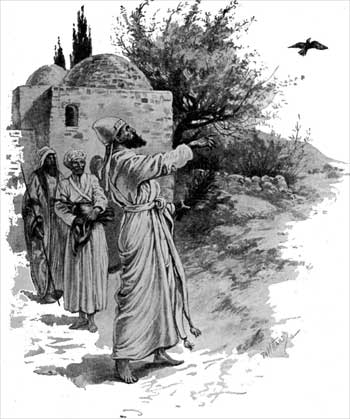
Behold the bird of God, who takes away the mold, mildew, and leprosy of the world?
Weʼve all heard the term “scapegoat,” but did you know it was based on holy commands given in the Hebrew Bible? God commanded that a priest transfer the sins of the people onto a live goat, and send the goat into the wilderness, thus carrying away the peopleʼs sins. (Lev. 16:20-22) We remember the scapegoat story, but we forget about the lowly scape-bird, a bird that God commanded a priest to transfer “uncleanness” to, then send flying into the sky. (Lev. 14:4-7,48-53) What kinds of “uncleanness” did the scape-bird carry away with it? Would you believe mold, mildew, and leprosy?
To the ancient mind discolored splotches of mold and mildew on clothing, leather or the walls of their homes, were lumped with that dreaded disease, leprosy. The same Hebrew word was used to describe them all, despite the tendency of modern Bible translators to make modern distinctions and use the words, ‘mold’ or ‘mildew,’ in cases of clothing and walls. The ancient Hebrews made no such distinctions but used the same word to describe a discolored growth on a wall, on poorly stored clothing, or on the skin of a leper. Consequently, the same remedy was required by Godʼs law.
Get your “scape-birds” here! They remove tough mold and mildew stains, as well as leprosy!
From Dave Matsonʼs article “Godʼs Ignorance Concerning Leprosy,” in his booklet, Commonsense Versus the Bible
Below is a response I recʼd from Chris Sharp, a sharp christian from the ASA forum.
(The American Scientific Affiliation is an organization of Evangelical Christians who are scientists, and whose membership is open to young-earth creationists but primarily includes old-earth creationists and theistic evolutionists. Their forum discussions are interesting.
http://www.asa.org
Chris first sites a paragraph of what I had written, replies to it, and then I respond to his reply below. Ed
Ed Babinski writes:
Does any Bible translation of Isaiah 40:22 drop the word circle and insert the word sphere into the text? I have not found one that does. In fact even Evangelical Christians have warned their brethren against the naivety of the spherical interpretation of Isaiah 40:22. (See for instance David C. Downingʼs book, What You Know Might Not Be So: 220 Misinterpretations of Bible Texts Explained (Baker Books House, 1987). Another Evangelical scholar, Paul Seely, has asked his brethren to note that one could just as well argue that God had revealed the sphericity of the earth to the Babylonians and the Egyptians because their writings also use the expression, the circle of the earth. We know, however, they believed the earth was flat. Isaiah 40:22 is logically incapable, therefore, of being a proof that the Bible speaks of the sphericity of the earth.
Chris Sharp: Hi Ed, Chris Sharp here.
Youʼre right. In fact you can just go to Google and type in the key words “bible flat earth hebrew” and come up with all sorts of interesting links, such as for example
“Flat Earth in the Bible?”
where are quoted:
1) Isaiah 40:22 - It is he that sitteth upon the circle (chuwg) of the earth.
and
2) Isaiah 22:18 - He will surely violently turn and toss thee like a BALL (duwr) into a large country: there shalt thou die, and there the chariots of thy glory shall be the shame of thy lordʼs house.
If Isaiah intended to mean the earth is a sphere in (1), why did he only use the word for a circle, rather than duwr for a globe, sphere or ball as in (2)? (Even if duwr needed a few added surrounding words to specify its context to make sure people recognize that a “ball” was being spoken about, Isaiah could have added that context too, IF he had been inspired to speak about the scientific shape of the earth.) Either he knew the shape of the earth or he did not. Apparently he did not. What I think examples like this demonstrate are that the shape of the earth was of no importance to his message or that of the Bible.
Henry Ford once said, “You can have a car of any color you like so long as it is black.” YECs (Young earth creationists) make a similar invitation when it comes to their discourses on the Bible and science, namely that the Bible and true science are always in agreement, but then in another breath, they say that when science disagrees with the Bible, the science is wrong, and thus untrue. Thus they only pay science lipservice while insisting that THEY are being “scientific.” As if it was “scientific” to insist on a 144 hour creation that took place about 6000 years ago, yet when the Bible talks about a stationary earth or a flat earth, they say that only symbolic language is being used. How do YECs know that the earth moves or is not flat, well of course they find that out from science, then try and interpret the Bible using that science! Isaiah 40:22 is a favorite among YEC apologists to say that the Bible is scientifically accurate. Another one is that the earth hangs on nothing.
As a Christian I am totally disgusted by the tactics used by YECs, which in many cases employ deception and obfuscation, thus are decidedly un-Christian in nature. The claims that YECs make in fact undermine the Bible and Christianity by proxy, because atheists will paint all Christians with the same brush. The veracity of the Bible is the theology behind it, not any science, and I think that people who try to defend the Bible with what passes for “science” among YECs are making a big mistake. Any science in the Bible is consistent with the knowledge at the time the relevant part of the Bible was written, and has to be understood within that context, and it may or may not correspond to modern knowledge. If the Bible is wrong about science, what does it matter?
A few weeks ago I was at a creation science presentation of Walt Brownʼs global Noahʼs flood hydroplate theory. After the presentation, I asked one of the YEC organizers, who was naturally an engineer rather than a biologist or geologist, what evidence would make him change his mind about a global flood. His answer in a single word was, “NONE.” I told him that that is dogma, not science. As soon as you “know” the answer to any research in advance, and no matter what the evidence is, you will not change your mind under any circumstances, you are no longer doing any science but are engaged in a dogmatic belief. I sent an e-mail later saying that if the remains of a large wooden boat were found on a mountain in eastern Turkey, along with some further evidence of itʼs approximate date and contents. I would be humble enough to consider such evidence in a scientific light as a possible disproof of my non-global theory of Noahʼs flood.
Another interesting link is
http://www.lhup.edu/~dsimanek/febible.htm.
—Christopher Sharp
Edward: Dear Chris,
Good points. Fundamentalism can indeed destroy faith.
But so can viewing the early chapters of Genesis as myth. (All religions have myths.)
So taking either stance has potential for loosening the breastplate around oneʼs chest, to paraphrase something Paul once wrote.
For those with curious minds itʼs an uphill battle to maintain oneʼs faith in a specific list of “must believe” (but unproven) dogmas. Just as itʼs an uphill battle to maintain oneʼs faith in the specific interpretations of a holy book that has spawned a great deal of rival interpretations (from Genesis to Revelation) over the ages.
The realization that Genesis, chapter one, was neither scientific nor historic, led me to consider that the story of the forbidden fruit, talking serpent, miraculous curses, animal-skinning Deity, and fiery-sword waving angel barring the coupleʼs return to Eden, might also be neither scientific nor historic, and so I had to consider that the worldʼs most inspired book starts off with a myth. That made me pause for thought.
My studies of the O.T., Intertestamental period, and N.T. period also gave me pause for thought.
In the end, I wondered about Jesusʼ atonement, and how Jesus and Paul could speak so plainly about a real Adam, when I had gotten to the point where I doubted there was an Adam and an Eve. I even began doubting that Jesus was “God” and that “God” had to sacrifice “God” to “God” in order to make atonement for the mythical failure of my distant ancestor from abstaining from a piece of fruit. My studies of cosmology also interfered further with my ability to maintain my former beliefs…
For, “So long as people believed, as St. Paul himself did, in one week of creation and a past of 4,000 years—so long as people thought the stars were satellites of the earth and that animals were there to serve man—there was no difficulty in believing that a single man could have ruined everything, and that another man had saved everything.” [Pierre Teilhard de Chardin, “Fall, Redemption, and Geocentrism,” Christianity and Evolution]
Other doubts also began occuring to me. The Old Testament taught, “The life is in the blood.” But science teaches today that if the “life” of an intelligent organism can be said to reside in a particular organ, that organ is the brain and nervous system, not the blood. The blood merely carries oxygen and nutrients to the brain. The brain guides the body and is far more intimately connected to each personʼs “life or soul” than the “blood” is.
Even people with less than a high school education today recognize the priority of the brain over the blood, so much so in fact, that in the movie, Hannibal (about a cannibalistic serial killer), the thought of slicing out tiny parts of a personʼs brain, cooking them in a pan, and serving the pieces to that person to eat has become in the publicʼs mind a more disturbing image than, say, serving a person a glass of their own blood to drink, which appears relatively tame in comparison. Because we know that a personʼs brain doesnʼt grow back like their blood, and we know that each personʼs “life/consciousness,” resides in the most valuable organ of all, the brain. Some people even opt to freeze their heads in liquid nitrogen after they die in hopes of one day being revived (with the help of nano-bots).
There also seems to have been a reduction in the number of sermons that focus on being “covered by the blood,” or “saved by the blood.” Today the phrase, “saved by blood” means receiving a blood transfusion, which does not change a personʼs brain/soul. Even the phrase, “Jesus shed his blood for you,” simply brings to mind the image of someoneʼs blood dripping onto the ground, not doing much for anyone at all.
I prefer a more “brain intensive” religion today, not one soaked in bloody metaphors mixed with magic.
And donʼt Christians wonder why killing Godʼs son was not the greatest sin of all? Or wonder how we could be forgiven for that sin, except by killing another savior whose blood must be shed to “atone” for the sin of killing the first one? And so forth and so on? At some point direct forgiveness, not based on a bloody sacrifice, has to intervene to break the endless loop.
Even Jesus taught that Godʼs forgiveness did not depend on a bloody sacrifice, but instead taught everyone to pray “in this way. Our Father. Forgive us our sins, as we forgive those who sin against us.” In other words, direct forgiveness.
I also grew to recognize the difference between having beliefs and having faith. Having beliefs is like clinging to a particular rock that is sticking out of an infinite sea, but having faith is letting go and learning to swim in that infinite sea. That is the kind of faith I now have.
Ed
Additional Questions About The Atonement
A Rochester filmgoer (after seeing the bloody religious epic, The Passion) was quoted as saying, “It was heartbreaking to know that I had put Jesus there on the cross, it wasnʼt the Jews and it wasnʼt the Romans, it was me and what I did.It was all of us, and that is why he had to die; for us.”
It is distressing to consider that there are lots of people who think their misbehavior drove the nails into the Saviorʼs wrists, that their sins punctured his side, just as surely as when they were fifteen their marijuana habit meant stealing twenties from their long-suffering fatherʼs wallet and finally caused his coronary.
R. Joseph Hoffman (for The Institute for Humanist Studies), “A review of The Passion of the Christ—A Mel Gibson Film,” first published February 2004
www.humaniststudies.org
Christians believe that God has established a bizarre system through which our sins are forgiven by the commission of the greatest sin of all [i.e., if murder is the greatest sin, then murdering Godʼs own son must be the “greatest sin of all.”—E.T.B.] This is a deicide to haunt the mind. That such a thing could arise from an eternal, all-loving, omnipotent God is beyond belief.
What are we to make of the juxtaposition of Godʼs requirement of this barbarous act with his directive that we should “love one another?”
The saving death of Jesus represents a primitive concept, the principle of blood sacrifice both of animals and of humans that was regarded by ancient and prehistoric man as the fundamental way to placate and intercede with the gods. It was part of the natural order. In fact it was so taken for granted that no one anywhere in the Bible, Old or New Testaments, offers a justification for it, or an explanation of how it works. Christians today are just as much in the dark about why the death of Jesus should have atoning power with God. Ironically, those same modern Christians would universally regard the ritual killing of humans or animals as outdated and repugnant in any other area of societyʼs life. And yet they continue to endorse it by their adherence to the idea of Jesus as a blood sacrifice on their behalf.
Earl Doherty, a review of “Mel Gibsonʼs The Passion of the Christ"
[The Jesus Puzzle webpage]
It seems to me that the most spurious of all the great religions is Christianity. Its Biblical miracles are childish, pre-scientific myths. Its theology has been taken right out of the caldrons of blood sacrifice and appeasement. For God so loved the world that he allowed the crucifixion of his only son to appease his own wrath, and then he denied eternal life to billions of human souls who refused to accept the gory myth.
Paul Blanshard (former minister), Personal and Confidential
Christianity has a built-in defense system; anything that questions a belief, no matter how logical the argument, is the work of Satan by the very fact that it makes you question a belief.
Bill Hicks (comedian)
Chipmunk Crucifixion
No chipmunk had to be crucified
on a tiny cross of twigs
To save all the other chippies,
Had to have nails pounded
through his little paws,
Had to take upon himself
all the sins of all the chippies
that ever were or would be
and die in agony
So that after they died
all the chippies
could live again forever,
But only if they believed
in all the sayings and doings
of the chipmunk crucified
on the tiny cross of twigs.
Antler, Last Words
A lot of Christians wear crosses around their necks. You think when Jesus comes back, heʼs gonna wanna see a cross? Maybe thatʼs why he hasnʼt shown up yet.
“Theyʼre still wearing crosses? When they start wearing fishes Iʼll go back, this is ridiculous. Theyʼve entirely missed the meaning of this thing.”
Itʼs like going up to one of the Kennedy clan with a rifle pendant on. “Just thinking of your tragically assassinated relative, president John F. Kennedy, I really loved him.”
Bill Hicks (comedian), Rant in E-minor, CD
We Christians neither want nor worship crosses as the pagans do.
Minucius Felix (Christian author, circa 200 A.D.)
It was only in the third century (after 400 A.D.) that Christian communities increasingly used “covert” crosses, which have survived in the murals of the catacombs and on tombstones. They might be an anchor with a crosspiece, a ship with a mast and yard, a human figure with outstretched arms, or a juxtaposition of the initials of the name Jesus or Christ (in Greek or Latin) to produce a cross-like shape. It was in the fourth century that the cross became an openly Christian symbol. By that time crucifixion as a method of state execution had been abolished and the cross ceased to have its former cruel and negative associations. Several hundred years later it was deemed a terrific symbol to use to ward off vampires, demons, etc.
E.T.B.
If Christ was executed today I bet Christians would wear little electric chairs round their necks.
Dick Gregory
After the missionary explained the Bibleʼs superior civilized plan of salvation to several natives, one of them replied, “Like you, we love our gods and seek to love one another. What we do not understand is why your god tried to pin down sin by using His son as a voodoo doll."
E.T.B.
Christianity is merely paganism with a more successful advertising campaign.
E.T.B.
Let me see if I have this straight. God sent His boy to His people, so that His people could kill His boy to save them from God?
NoGodHere (in “God is a Myth” AOL chatroom)
Letʼs not forget that Jesus (after a few hours of pain) rose from the dead and ascended to a throne in heaven. So in essence, nobody really “killed” Jesus; it was more like a fraternity hazing, or an early version of the TV show, “Fear Factor,” where you endure all kinds of shit to win a valuable prize.
T-Shirt Hell Newsletter, 2/25/04
“Civilization will fail without Christianity,” at least thatʼs what Christians have emailed me on their computers designed by agnostics (in America) and Buddhists (in Japan). Communists (in China) have also begun producing computers and will soon have hundreds of millions of them.
“Civilization failed, even with Christianity” would be more to the point, especially in view of the fall of the Christianized Roman Empire. Also, the Southern U.S. fell to the troops of the North during the Civil War, even though the South believed it was Godʼs new chosen nation and had added an invocation to “God” in their Southern Constitution. Today, America is the most church-filled nation on earth and also spends more money on weapons of mass destruction than all other nations combined. America also has more obesity and more of its citizens in prison than any other nation on earth. Neither do Americans live the longest (even Canadians live longer than your average American), nor do we have the highest average school test scores, nor do we have the lowest rates of teen pregnancy—not when compared with nations with far fewer churches.
E.T.B.
To paraphrase John 3:16, “For God so loved the world that he temporarily died to save it from himself. But none of that really matters because most people will be tortured for eternity anyways.”
Matt Miller
Christianity teaches that Jesus had to die, or God couldnʼt forgive the world.
So why isnʼt Judas a “Saint?”
E.T.B.
Whenever I forgive someone Iʼm relatively straightforward and direct about it. But for God it takes a bloody miracle.
E.T.B.
Conversation, A.D. 33
A: Have you heard the latest?
B: No, whatʼs happened?
A: The world has been redeemed!
B: You donʼt say!
A: Yes, the Dear Lord took on human form and had himself executed in Jerusalem; and with that the world has been redeemed and the devil hoodwinked.
B: Gosh, thatʼs simply lovely.
Arthur Shopenhauer
I am impaled on a big giant stick with Christ: nevertheless I somehow magically live; yet not I, but Christ magically lives in me through the Power of the Holy Spook who is also somehow magically Him: and the life which I now live in the flesh I live by thinking magically about the Son of God, who loves me from the Sky Kingdom, and magically gave himself for me to appease the murderous anger of the pissed off version of Himself in the Sky Kingdom.
Galatians 2:20 (Jeff Reid Version, composed by “Brother Jeff L. Reid”

