
And how can people be blamed eternally simply for relying on experts to fill in the gaps concerning things in which none of us has thorough expertise?
Because the matters central to salvation do not rely on such a high level of expertise. Anyone has access.
Edward: Non-answer. Anyone has access to Mormonism too. The book of Mormon says all you have to do to know if that book is true is to read it and then pray and ask God if it is so. Thatʼs all, instant access. The Christianʼs claim the same thing, pray a prayer, and youʼll know itʼs true. But then once you are a member of their church they stick you with their Holy Book, and additional commentaries, inspirational materials, etc., so you “understand the holy book right.”
Even the order of creation in Genesis echoes the Babylonian Enuma Elish.
No kidding. Yet as Heidel showed, the former cannot be derived from the latter. Why not attribute both to a common core as he indicated the evidence shows?
Edward: Why not recognize the “common core” as being the ancient near eastern milieu in general? Besides, the similarities are more striking than Heidel even discusses in his book. And the influence of the annual Enuma Elish readings and creation festivals in Babylon during the captivity of the Jews there probably made the Jews realize they needed a fancy dancy creation account of their own. The ancient near eastern milieu also included henotheism, the belief in one high god raised above the rest. And the same phrases that described Marduk are echoed in the Old Testament. And traces of henotheism also exist in the Old Testament, as in “ye shall have no other gods before me.” Thereʼs books that list exact parallels between ancient near eastern literature and the Old Testament, laying them out verse by verse. Do you think the laws of Moses arose out of thin air? Hammurabi beat Moses to it, and his laws are show in stelles as being dictated right to Hammurabi by the god Shamash. Later, the Jews pulled the same trick, their laws being delivered right to Moses. And the Jews copied phrases and the general outlines of the Hammurabi code as well.
Moreover, the borrowings do not end with the creation accounts.
Borrowings from ancient wisdom literature found in the book of Proverbs have also been documented.
And the problem with this is what, exactly?
Edward: The problem is that the book of Proverbs contains examples of sayings totally lifted from other ancient sources that archaeologists agree existed before Solomonʼs day, and that means there is proof that the “wisdom of proverbs” wasnʼt all simply passing out of the Jewish nation into the world, but the Jews were incorporating information from the cultures around them into their holy Scriptures. Even the layout of the format for the book of Proverbs was lifted from a previous wise sayings collection that is now known. In other words Plagiarism. The ancients stole from one another without footnotes. All sorts of borrowings were going on. The Bible is a collection of stuff whose origins are unfootnoted and lost in time.
And when there are footnotes, which happens exceedingly rarely in the Bible, they raise questions of their own. Take the case of the Book of Jashar which is listed as a footnote in the Biblical Book of Joshua. The Book of Joshua admits that it quotes from “The Book of Jashar” when it comes to Joshuaʼs exact words spoken to “stop the sun.” Joshua 10:12 On the day the LORD gave the Amorites over to Israel, Joshua said to the LORD in the presence of Israel:
“O sun, stand still over Gibeon,
O moon, over the Valley of Aijalon.”
13 So the sun stood still,
and the moon stopped,
till the nation avenged itself on its enemies,
as it is written in the Book of Jashar.
Weirdly enough, the Bible lists the Book of Jashar as a source for two biblical events. One such event is Joshuaʼs command to stop the sun, and another concerns the life of king David!
2 Samuel 1: Davidʼs Lament for Saul and Jonathan
- David took up this lament concerning Saul and his son Jonathan,
- and ordered that the men of Judah be taught this lament of the bow — it is written in the Book of Jashar:
- “Your glory, O Israel, lies slain on your heights. How the mighty have fallen!
Doesnʼt that imply that the Book of Jashar was written or at least completed during the era of King David since it mentions him? And who is this “Jashar” fellow? But then, if the book of Jashar was written in the era of King David, it doesnʼt contain a very “fresh memory” of Joshua, does it, since Joshua lived hundreds of years before King David. Yet the author of the Book of Joshua would sooner quote from the Book of Jashar for Joshuaʼs words, rather than get them straight from Joshua himself?
As well as the well documented practice of exaggerations regarding battle victories, or the numbers of enemy slain, or sizes of armies, or amount of booty captured, such exaggerations being rife at that time.
Vague generalizations.
Edward: Thereʼs a grad paper by a Dallas Seminary Student that mentions how common such exaggerations were and he lists examples, and argues at that Evangelical institution that the numbers of the Exodus in the Bible are likewise exaggerations. I guess even the Evangelical scholarly world is passing Bob by. The name of the student and his paper is mentioned in an appendix in Leaving the Fold.
Itʼs also well documented that biased moderns have a problem assuming that ancient writers exaggerate.
Edward: So when Chronicles doesnʼt agree with Kings as to the number of the kingʼs horses, etc., but is off by thousands (tens of thousands), thatʼs not an exaggeration? When the size of Israelite armies is more phenomenal than anything archaeologists can possibly imagine, thatʼs not exaggerations? When the Bible says that Solomon had “had seven hundred wives, princesses and three hundred concubines” (1 Kings 11:3), in other words an even thousand, thatʼs not an exaggeration? When the Bible says that Solomon had 81% of the same amount of gold that currently lies at Fort Knox. [“A hundred thousand talents of gold, a million talents of silver, quantities of bronze and iron too great to be weighed, and wood and stone” (1 Chron. 22:14) The NIV Bible says that a hundred thousand talents of gold is equal to 7.5 million lbs. The U.S. federal gold depository at Fort Knox holds only 19% more than that, or 9.2 million lbs. Itʼs difficult for anyone today to believe that ancient kings, ruling over relatively parched and moderately populated lands like ancient Palestine, lacking modern methods and machines for gold mining and refining, could have accumulated 81% of what currently lies at Fort Knox. Likely, the author of 1st Chronicles was inflating the wealth of King David and King Solomon just as he inflated the numerical sizes of their armies — after all, “a hundred thousand talents of gold,” is a nice large round figure. ]
Hey, but go pull Deverʼs beard (if he has one) and let me know if he hollers when you try to explain to him that the Bible contains no “exaggerations.”
You want more? The Bible, like tons of holy books is filled with exaggerated speech and language or all types, not just numerically.
If you donʼt see them, then you are blinded by far more than just “Satan,” more like youʼve been blinded by the “snake-headed Gorgon” known as “Evangelical religion,” because your head must have turned to stone:
Exaggerations Of Biblical Proportions
The camels were without number as the sand of the sea.
- Judges 7:12
What an exaggeration, closer to a boastful lie than the truth. If the entire surface of the earth was filled with camels they would not be “without number,” nor would they be as plentiful as “the sand of the sea.”
- E.T.B.
As the host of heaven cannot be counted, and the sand of the sea cannot be measured, so I will multiply the descendants of David.
- Jeremiah 33:22
What an exaggeration, closer to a boastful lie than the truth. The number of Davidʼs descendants is nowhere near the number of stars in heaven, or sand in the sea.
- E.T.B.
Among all this people there were seven hundred chosen men left-handed; every one could sling stones at a hairʼs breath, and not miss.
- Judges 20:16
Seven hundred who could sling stones at “a hairʼs breath,” and “not miss?” Iʼm surprised the authorʼs nose didnʼt grow when he told that one. Even the greatest sharp shooters at the turn of this century, who performed in Wild West traveling shows, and shot cards out of each otherʼs hands, did not retire with all their fingers — because they “missed” some shots by “a hairʼs breath.”
- E.T.B.
Their slain shall be cast out, and their stink shall come up out of their carcasses, and the mountains shall be melted with their blood.
- Isaiah 34:3
Talk about an exaggeration guaranteed to turn your stomach. To “melt a mountain” with “blood” would require a helluva lot of blood. Isaiah must have been confusing mountains with molehills.
- E.T.B.
The famine was over all the face of the earth… And all countries came unto Egypt to Joseph to buy corn; because the famine was so sore in all lands.
- Genesis 41:56,57
Donʼt the words, “over all the face of the earth. all countries. all lands” mean “over all the face of the earth. all countries. all lands?” If they mean what they say, then even folks in far off China and Japan and Australia and North and South America must have been “sorely famished” and had to go to “Egypt” to buy corn! Or else, “over all the face of the earth. all countries. all lands” is an exaggerated way of speaking, closer to a boastful lie than the truth.
- E.T.B.
[In one of the plagues with which the Lord smote Egypt] All the dust of the land became lice throughout all the land of Egypt.
- Exodus 8:17
Doesnʼt the Bible use the word “dust” to describe the ground, mud, and sand upon which we all walk as in “the dust of the earth?” Therefore if “all the dust of the land became lice” would not the Egyptians have drowned in lice and the pyramids been adrift in seas of lice? “Knock, knock.” “Whoʼs there?” “Lice.” “Lice Who?” “Run for your lice!”
- E.T.B.
In one plague with which the Lord smote Egypt “all the cattle of Egypt died.” But a few days after that, “all the firstborn cattle died.”
- Exodus 9:6 & 12:29
How could any cattle be left to smite after “all the cattle” had already been smitten? Are we to believe that the Lord resurrected the “firstborn” among the cattle just so he could smite them again?
- E.T.B.
[The Lord said to the Israelites when they were wandering in the desert] “This day will I begin to put the dread of thee and the fear of thee upon the nations that are under the whole heaven, who shall hear report of thee, and shall tremble, and be in anguish because of thee.”
- Deuteronomy 2:25
Donʼt the words, “the nations that are under the whole heaven” mean “the nations that are under the whole heaven?” If they mean what they say, then even the distant nations of China and Japan and the Native American nations — to name just a few of the many “nations that are under the whole heaven” — must have been trembling in their boots, having “heard report of Israel.” Or else, “the nations that are under the whole heaven” is an exaggerated way of speaking, closer to a boastful lie than the truth.
- E.T.B.
The Exaggerated Abundance of the “Promised Land”
In the year 1553 Michael Servetus was on trial for his life in Geneva, Switzerland on the charge of heresy. One point raised by the prosecution was Servetusʼs edition of Ptolemyʼs Geography, in which Judea (the “promised land” of the Jews), was spoken of, not as “a land flowing with milk and honey,” but mainly meagre, barren, and inhospitable. In his trial this simple statement of geographical fact was used against him by Protestant Refomer, John Calvin, with fearful power. In vain did Servetus plead that he had simply drawn the words from a previous edition of Ptolemy; in vain did he declare that this statement was a simple geographical truth of which there were ample proofs; it was answered that such language “necessarily inculpated Moses, and grievously outraged the Holy Ghost.”
- A. D. White, A History of the Warfare of Science with Theology in Christendom, Vol. 1
Exaggerated Promise
I have set my king upon the holy hill of Zion. Ask of me, and I shall give thee the heathen [as slaves] for thine inheritance, and the uttermost parts of the earth for thy possession. Thou shalt break them with a rod of iron.
- Psalm 2:6,8,9,12
The above psalm is believed to have been sung at the coronations of Hebrew kings. But giving a king, “.the uttermost parts of the earth for thy possession” is an exaggerated promise to say the least. (Though it must be admitted that this psalm later proved popular with some Catholics and Protestants who used it to justify their “breaking” of the “heathen,” driving them into slavery and stealing their land in alleged fulfillment of this exaggerated Biblical promise.)
- E.T.B.
[Jesus said] “The Queen of the South [i.e., the Queen of Sheba] came from the uttermost parts of the earth to hear the wisdom of Solomon.”
- Matthew 12:42
The Queenʼs residence, being probably on the Arabian Gulf, could not have been more than twelve or fourteen hundred miles from Jerusalem. If that is the “uttermost parts of the earth” then it is a small world after all.
- E.T.B.
All the kings of the earth sought the presence of Solomon, to hear his wisdom.
- 2 Chronicles 9:23
Donʼt the words “all the kings of the earth” mean “all the kings of the earth?” If they mean what they say, then even Incan and Aztec kings in South America must have begun paddling their long boats toward Israel the instant they heard how wise king Solomon was. Or else, “all the kings of the earth” is an exaggerated way of speaking, closer to a boastful lie than the truth.
- E.T.B.
The devil took him [Jesus] up into an exceedingly high mountain, and showed him all the kingdoms of the world, and the glory of them.
- Matthew 4:8
Shown “all the kingdoms of the world” from an “exceedingly high mountain?” I suppose so, if the mountain was “exceedingly high” and the earth was flat. Verses in the Bibleʼs book of Daniel presume a flat earth the same way that verses in Matthew do:
I saw a tree in the midst of the earth, and the height thereof was great. The tree grew, and the height thereof reached unto heaven, and the sight thereof to the end of all the earth.
- Daniel 4:10-11
Instead of an “exceedingly high” mountain from which “all the kingdoms of the earth” can be seen, Daniel pictures a tree “whose height was great,” growing from the “midst” or center of the earth and “seen” to “the ends of all the earth.”
Funny how such flagrantly flat-earth verses appear in both the Old and New Testaments. “Bible believers” will of course reply that such verses are only “apparently difficult” to explain, and not the “real truth” as they see it. But it is the “apparent difficulties” that remain in the Bible, as it was written, and they will always remain there, regardless of all the ingenuity employed in explaining them away.
- E.T.B.
A decree went out from Caesar Augustus that a census be taken of all the inhabited earth.
- Luke 2:1
Donʼt the words, “all the inhabited earth” mean “all the inhabited earth?” If they mean what they say, then even the Chinese must have taken part in Augustusʼ census! Or else, “all the inhabited earth” is an exaggerated way of speaking, closer to a boastful lie than the truth.
- E.T.B.
And there were dwelling at Jerusalem Jews, devout men, out of every nation under heaven.
- Acts 2:5
“Out of every nation under heaven?” A Jew from the nation of the Sioux Indians in North America was there too? Or maybe Luke was not talking about a very wide “heaven?”
- E.T.B.
A great famine all over the world took place in the reign of Claudius.
- Acts 11:28
Donʼt the words, “all over the world” mean “all over the world?” If they mean what they say, then the Chinese, Japanese and Native Americans who lived in the world during the reign of Claudius must have suffered the effects of that great famine. Or else, “all over the world” is an exaggerated way of speaking, closer to a boastful lie than the truth.
- E.T.B.
Paul the apostle wrote:
Their voice [of first-century proclaimers of the Christian Gospel] has gone out into all the earth, and their words to the ends of the world.
The mystery is now manifested and. has been made known to all the nations.
The gospel, which has come to you, just as in all the world.
The gospel. which was proclaimed in all creation under heaven, and of which I, Paul was made a minister.
- Romans 10:18; 16:25-26; Colossians 1:5-6,23
What an exaggeration. Sorry Paul, but “Their voice” (of Christians proclaiming the Gospel) had only reached a handful of churches in the Roman Empire when you wrote the above verses. The Gospel had not reached, nor been proclaimed in “all the earth,” nor “to the ends of the world,” nor “to all nations,” and certainly not “in all creation under heaven,” not like you said it “has” and “was.”
The early church father, Irenaeus, maintained Paulʼs charade when he wrote: “Now the Church, spread throughout all the world even to the ends of the earth; “…even though she has been spread over the entire world;” “Anyone who wishes to see the truth can observe the apostleʼs traditions made manifest in every church throughout the whole world.” (Irenaeus, Against Heresies, 1.10.1, 1.10.2, 3.3.1-2) Not a very big “world,” mind you, leaving out most of Asia and Africa, not to mention the continents of Australia, North America and South America.
Summation of the “Exaggerations of Biblical Proportions
If an all-wise God had inspired the Bible He would have been able to give its human authors a few inspired geography lessons, just to show them how big the earth really is. Instead the Bible contains the same exaggerated speech, boastful lies and holy hyperbole common for its day and age, i.e., rather than evidence of special inspiration.
Furthermore, if the Bible is not speaking absolutely truthfully when it speaks of “all the earth,” “to the ends of the earth,” “from the uttermost parts of the earth,” “all the inhabited earth,” “in all creation under heaven,” “under all the heavens,” “every nation under heaven,” then how can anyone be expected to assume the truthfulness of the statement, “everywhere under the heavens,” when it is found in the tale of the Flood of Noah in Genesis? (It says in Gen. 7:17, “The water prevailed. and all the high mountains everywhere under the heavens were covered.” Why couldnʼt this instance of the phrase, “everywhere under the heavens,” be yet another boastful exaggeration and mythical way of speaking? Perhaps the “Flood” story is a myth? Hmmm, do ya think?)
Having run across so many instances of exaggerated speech in the Bible one even wonders what is to become of the central Christian boast, the exaggeration par excellence, namely that Jesus died “for the sins of the world?” Believers from every sacred tradition boast that their beliefs affect the “world,” or must be taken seriously by the “world.” Must they indeed? I find that I cannot take seriously many instances in which Biblical authors exaggerate (boldly lie about) the extent of a famine, a census, the distance to a queenʼs residence, the extent to which a message has been spread, the extent of a flood, etc. Indeed, didnʼt “orthodox” Christian doctrines and theology arise via exaggerating the importance of some interpretations of the alleged sayings and doings of Jesus above other rival interpretations?
- E.T.B.
The Exaggeration Found at The End of the Fourth Gospel
The Gospel of John ends with this great exaggeration:
And there are also many other things which Jesus did, the which, if they should be written, every one, I suppose that even the world itself could not contain the books that should be written. Amen.
- John 21:25
The “world” could not contain the books? The books we do have that tell of “things Jesus did,” consist of four slim “Gospels,” not one of them over forty pages in length. Two of them, Matthew and Luke, even repeat over 90% of what appears in Mark. So the four Gospels minus the overlapping portions would be even slimmer.
To reiterate the last sentence in the fourth Gospel:
And there are also many other things which Jesus did, the which, if they should be written, every one, I suppose that even the world itself could not contain the books.
- John 21:25
Is there a less convincing way for an allegedly “inspired” book to end?
Just notice the authorʼs use of the faltering phrase, “I suppose.”
“I suppose” such exaggerated speech made sense to believers back then, who were being entertained by ever new and fabulous tales of Jesusʼ infancy, youth and adulthood churned out by their fellows and incorporated into additional “Gospels” many of which we only know the titles of today. But really, ending an inspired book with a huge exaggeration, followed by the faltering words, “I suppose,” doesnʼt make much of an impression on me.
- E.T.B.
Exaggerated Commands: “Cut and Pluck” to Avoid “Hell”
Take the following verses:
[Jesus said] If thy right eye offend thee, pluck it out, and cast it from thee: for it is profitable for thee that one of thy members should perish, and not that thy whole body should be cast into hell. And if thy right hand offend thee, cut it off, and cast it from thee: for it is profitable for thee that one of thy members should perish, and not that thy whole body should be cast into hell.
- Matthew 5:29-30, repeated redundantly in Matthew 18:8
[Jesus said] If thy hand or thy foot offend thee, cut them off, and cast them from thee; it is better for thee to enter life halt or maimed, rather than having two hands or two feet to be cast into everlasting fire.
- Matthew 18:8
[Jesus also taught] All men cannot receive this saying, save they to whom it is given. For there are some eunuchs. which have made themselves eunuchs for the kingdom of heaven. He that is able to receive it, let him receive it.
- Matthew 19:12
The inspired words concerning “cutting off” body parts to avoid being “cast into hell,” along with Jesusʼ praise of those who “made themselves eunuchs for the kingdom of heaven,” made a deep impression on Origin (an early church Father). He castrated himself.
And in the 1700 to 1800s a group of Christians in Russia called the Skoptzies cut off their own testicles and scrotums. Female members mutilated their vulvas, breasts and nipples. (“For the days are coming, in the which they shall say, Blessed are the barren, and the wombs that never bare, and the paps which never gave suck.” Luke 23:29) Furthermore, they taught that if you also removed your penis (or removed both breasts if you were female) you would be granted the highest honors in heaven. Apparently with the aid of a perfect holy book like the Bible and with the promise of the Holy Spirit to “lead believers into all truth,” this was the truth that the Skoptzies came up with. Bodily sexual temptations could lead to hell, so if mutilating the body aided a person in denying those temptations, it increased oneʼs chances of avoiding hell and attaining heaven.
Maybe God could have used less emphatic language and not linked the cutting off of body parts with avoiding hell? “Let him who has ears to hear.”
“Whaaat? I canʼt hear you, I recently cut my ears off. They ‘offended’ me. And I would rather be in heaven without them than be cast into everlasting fire with them.”
- E.T.B.
Too Much Reverence for the Literal Words of the Bible Coupled with Too Much “Fear of God?”
Mr. Passmore thought he saw the number 666 on his right hand and so he used a circular saw to follow the teaching of the Bible, “If they right hand offend thee, cut it off, and cast it from thee, for it is better to enter eternal life maimed than have two hands and be cast into everlasting fire.” He then refused surgery at the Sentara Norfolk General Hospital in Virginia, saying he thought he would go to hell if the hand were reattached. Now, however, he has filed a lawsuit claiming that the hospital where he was treated was negligent in that they didnʼt contact his parents or his sister and get them to override his decision. Passmore is thirty-two years old.
- J. D. Bell, “Nuts in the News,” The American Rationalist, Sept./Oct. 1996
An Exaggerated Command: “Give to Everyone Who Asks”
[Jesus commanded] Give to him that asketh thee, and from him that would borrow of thee turn not away.
- Matthew 5:42
Give to every man that asketh of thee; and of him that taketh away thy goods ask them not again. But love ye your enemies, and do good, and lend, hoping for nothing again; and your reward shall be great, and ye shall be the children of the Highest: for he is kind unto the unthankful and to the evil.
- Luke 6:30,35
Next time an evangelical Christian targets you with their soul-seeking missiles, tell them to look up the above verses and read them aloud. After which, ask them for their Bible. If they do not give you their Bible then ask them to please turn to the end of the same sermon in which Jesus spoke the verses above, and read aloud what Jesus said at the very end of that sermon, emphasizing the word “doeth”:
Not every one that saith unto me, Lord, Lord, shall enter into the kingdom of heaven; but he that doeth the will of my Father… Many will say to me in that day, Lord, Lord, have we not prophesied in thy name? and in thy name have cast out devils? and in thy name done many wonderful works? And then will I profess unto them, I never knew you: depart from me, ye that work iniquity. Therefore whosoever heareth these sayings of mine, and doeth them, I will liken him unto a wise man. And every one that heareth these sayings of mine, and doeth them not, shall be likened unto a foolish man.
- Matthew 7:21-24,26
Remind your evangelical friend that if they do not “doeth” what Jesus commandeth them, they risk hearing Jesus say unto them, “Depart from me, ye that work iniquity!” Is that what they want to hear Jesus say to them? Or do they want to give you their Bible, since you asked them for it?
After they have handed it over, tell them, “Thank you,” and say that you donʼt want to keep their Bible forever, nor destroy it. You would just like them to read a few books about the Bible, books that take a more “inquisitive” approach to the Bible and Christianity, like Chicken Soup for the Damned Soul: The Damned say the Damndest Things. And then you will return their Bible to them.
Speaking of “giving to all who ask,” hereʼs an idea for the IRS to try. They should print Mat. 5:42 and Luke 6:30 on all tax forms. Beneath the verses should be a little note from the IRS that says, “We ask all Bible believing Christians, especially wealthy televangelists and pastors of mega-churches, to not claim religious tax exemptions this year.”
In fact, I invite everyone to ask their “Bible believing Christian” friends for money every day and keep asking, especially any fat cat Christian ministers they might know. Call their TV stations and radio stations, stand up in their mega-churches, etc., and quote the above verses and ask them for money. There is no limit put on the above commands.
- E.T.B.
An Exaggerated Promise: “You Wonʼt Be Hurt”
And these signs shall follow them that believe; In my name. They shall take up serpents; and if they drink any deadly thing, it shall not hurt them.
- Mark 16:17-18
This promise (which does not appear in the earliest known manuscripts of the Gospel of Mark) has inspired crippling illnesses and fatalities, including the death of the founder of the “serpent-handling” sect of Baptists who died from a poisonous snakebite.
Of course, if any Christians truly believe that “if they drink any deadly thing, it shall not hurt them,” why donʼt they move their families to homes built on toxic landfills which they could buy for a prayer?
Toxic Acres is the place for me!
Mark 16 lets me live there comfortably.
Land spreadinʼ out so cheap and wide.
Keep sin city just gimmie that DI-OXIDE!
- E.T.B.
Exaggerated Numbers of People Wandering in the Desert for Forty Years
According to the Bible the number of people who followed Moses out of Egypt during the Exodus was “about six hundred thousand on foot that were men.” (Ex. 12:37) To that number must be added women, children, and a “mixed multitude” of non-Hebrews who followed Moses out of Egypt, raising the total way above the six hundred thousand Hebrew males, and nearer to a grand total of two million men, women and children. That is like the population of New Orleans (or Columbus, Ohio, or San Antonio, Texas), being kept on the move (following “a pillar of smoke by day and a pillar of fire by night”) every day for forty years. The only day of the week they were not moving was the Sabbath day. Thatʼs a heap of packing and unpacking — of setting up “camp” and breaking it down again. Plus we are to believe they also performed necessary sacrificial/sacramental duties for two million people, and the men all walked “outside the camp” (a really huge camp) each time they had to go to the bathroom.
The Bible only mentions Aaron and his two sons as being available to conduct all the burnt-offerings, meat-offerings, peace-offerings, sin-offerings, trespass-offerings, thank-offerings for all of the Israelites. (Num. 3:10) Just the number of pigeons to be brought as sin-offerings for newly born children, would have averaged, based on a multitude of nearly two million, more than 250 a day, not counting all the bulls, sheep, lambs, rams, goats, and turtle doves needing to be sacrificed for reasons too numerous to mention — and their carcasses having to be ceremonially bled, the fat removed meticulously, the organs burned as an offering to God, and the carcass dragged “outside the camp” to be burned (a camp of perhaps 16 miles in diameter).
Miraculously, these two million or so Israelites left no traces of their forty-years in the wilderness. No traces of encampments, tent holes, potshards (or other items discarded during their marches), nor traces of their daily sacrifices — no evidence of large charred ash deposits nor blackened stones nor bones. (Oddly enough archaeologists have discovered the remains of a small fire in the Sinai wilderness that was carbon-dated back to about that time. But one small fire could not have warmed the alleged two million who marched nearly every day for 40 years up and down the Sinai.)
So staggering are the problems raised by the exaggerated Biblical number of “600,000 males” (an embarrassingly well attested number, repeated three more times in the Bible — on each occasion each separate tribe being numbered, the sum of the results making up the whole), that even conservative Christian scholars have admitted that “600,000 men,” beside children, women, and the mixed multitude, is an exaggeration on par with many others found in ancient Near Eastern lore.
Evangelical Christian, W. M. Flinders Petrie, author of Egypt and Israel (London Society for Promoting Christian Knowledge, 1911) pointed out, “There are. two wholesale checks upon the total numbers. The land of Goshen recently supported 4,000 Bedouin living like the Israelites, or at present holds 12,000 cultivators. To get “600,000 men” with their families out of that district would be utterly impossible. Also on going south the Israelites had almost a drawn battle with the Amalekites of Sinai. The climate of that desert peninsula has not appreciably changed; it will not now support more than a few thousand people, and the former inhabitants cannot have exceeded this amount. How could the Israelites have had any appreciable resistance from a poor desert folk, if they outnumbered them as a hundred to one? Again, we are compelled to suppose that the Israelites were not more than a few thousand altogether. Thus we see that more cannot be got out of Goshen or into Sinai.”
- E.T.B.
Exaggerated Sizes Of Armies in the Bible
In the 18th century, Frederick the Great had an army of 83,000 troops when he became King of Prussia. Other states — Austria, France, and Russia — fielded larger armies, but rarely did they approach 100,000 troops. Frederickʼs greatest victories — Rossbach and Leuthen — involved about 75,000 and 115,000 troops respectively on both sides. Napoleonʼs greatest victory - Austerlitz — involved about 150,000 troops total. So did Gettysburg, Americaʼs greatest Civil War battle. Alexander the Great, who controlled Greece, Macedonia, Thrace (Southern Yugoslavia), and a little bit of Western Anatolia, was able to raise between 90,000 and 100,000 troops total. Yet the Bible says that Hebrew kings, David and Saul, fielded far larger armies than those. King David had 1.57 million troops (1 Chron. 21:5)… or 340,000 plus the muster of Issacher… or 1.3 million (depending on which verses you read). While King Saul could field 210,000 troops. (1 Sam. 15:4)
Did the dry scrubland of Judea — populated by scattered villages and small settlements — raise up armies larger than the Persian Empireʼs when it faced destruction at Alexanderʼs hand, larger than Frederick the Greatʼs, larger than Napoleonʼs in all his battles save the invasion of Russia, larger than the Unionʼs and Confederacyʼs in their epic struggle? Truly such a feat must constitute one of the least heralded miracles in the Bible.
In the ancient world only the greatest powers, such as the Bronze Age Egyptians, Hittites, Assyrians, Babylonians, and later the Persians, fielded armies upward of 50,000 or more. When Egyptʼs king Ramesses II fought the Hittites at Kadesh in about 1285 B.C.E., he recorded their force as 37,000 infantrymen and 3,500 chariots and said that the Hittites mustered much of the military power of their empire, which covered most of Anatolia, Syria, and a bit of Iraq (Sir Alan Gardiner, The Kadesh Inscriptions of Ramesses II, 1975, p. 41-42). Ramesses had possibly the largest army Bronze Age Egypt ever fielded. It is worth noting that in his poetic account of the battle of Kadesh, Ramesses claimed to have personally killed “hundreds of thousands” of Hittites and their allies (Ibid., pp 10-13), and Ramesses probably lost the battle. (Propaganda was invented long before the Israelites appeared.)
- William Sierichs, Jr., “Those Amazing Biblical Numbers: Taking Stock of the Armies of Ancient Israel,” The Skeptical Review, Vol. 6, No. 1, 1995
Exaggerated Numbers of People Slain
According to the Bible, Abishai & Jashobeam each slew 300 men using only a spear (2 Sam. 23:8 & 1 Chron. 11:11). But thatʼs nothing, because Shamgar slew 600 men with an ox-goad (Judges 3:31). And Adino slew 800 with a spear (2 Sam. 23:8) Do ya suppose Adino was the inventor of Shish-ka-bob? Last but not least, Samson slew 1000 men with the jaw-bone of an ass (Judges 15:15). If only their techniques in the lethal arts of the “spear,” the “ox-goad” and the “jaw-bone” had been preserved for posterity, imagine what martial arts films Chinese directors could make today, featuring hundreds of deaths in one long (and obscenely bloody) scene!
- E.T.B.
Exaggerated Ages of the Biblical Patriarchs
It is certain that one cannot build up a chronology on the spans of years attributed to the Patriarchs, nor regard it as factual that Abraham was seventy-five years old when he left Harran and a hundred when Isaac was born and that Jacob was a hundred and thirty when he went into Egypt, for the evidence from the skeletons in the Jericho tombs shows that the expectations of life at this period was short. Many individuals seem to have died before they were thirty-five, and few seem to have reached the age of fifty.
- Dr. Kathleen Kenyon (the eminent~excavator of the city-mound of Jericho)
Why Evangelical Theologians Grade Godʼs Writing On A Curve
If I was teaching a class in the art and craft of writing, I would have to ask God what message he was trying to convey to his readers. His emotions and sentiments, like those of his characters, are on a constant roller coaster ride.
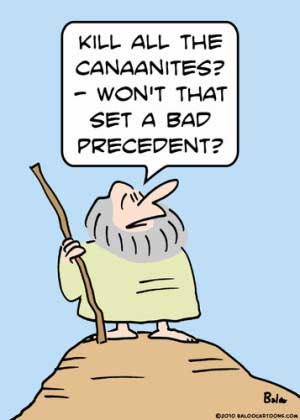
For example in the book of Exodus, Moses descends from a mountain holding Ten Commandments, one of which says, “Do not kill.” Plain enough. But Moses saw that some of the people had begun worshipping idols, so he said, “Kill every man your [idol worshipping] neighbor.” (Ex. 32:27). How do you get that from “Do not kill?”
And how can you confuse “Kill every man your neighbor” (Ex. 32:27) with “Love your neighbor?” (Lev. 19:18 & the Gospels).
And we are also to believe, based on the Bible that the same Moses who taught “Do not kill” also commanded the Israelites to “kill every [Midianite] male among the little ones.” (Num. 31:17)
And what about the use of the word “Blessed” to describe two very different sentiments in Matthew 5:9 and Psalm 137:9, respectively: “Blessed are the peacemakers, for they shall be called the sons of God.” “Blessed will be the one who dashes your little ones against the rock.”
Or take Psalm 34:14, “Seek peace, and pursue it,” and add the equally peace-loving, “Blessed are the peacemakers, for they shall be called the sons of God” (Mat. 5:9).
And compare them with Jesus allegedly saying, “Do you suppose that I came to grant peace on earth? I came not to bring peace, but a sword.” (Mat. 10:34)
Or compare Luke 2:14, “Peace on earth, good will toward men [at Jesusʼ birth]” with this verse: “Do you suppose that I [Jesus] came to grant peace on earth? I tell you, no, but rather division. I have come to cast fire on the earth and how I wish it were already kindled.” (Luke 12:49,51)
Or compare Matthew 5:7, “Blessed are the merciful” with the following verses:
“Leave alive nothing that breathes. show them no mercy.” (Deut. 7:2)
“The Lord hardened their hearts… that they might receive no mercy.” (Joshua 11:20)
“I will dash them one against another, even the fathers and the sons together, saith the Lord: I will not pity, nor spare, nor have mercy, but destroy them. A curse on him who is lax in doing the Lordʼs work! A curse on him who keeps his sword from bloodshed.” (Jer. 13:14; 48:10 — NIV)
Or compare Matthew 5:44, “Love your enemies and pray for those who persecute you” with “Chase your enemies and they will fall before you by the sword.” (Lev. 26:7)
Or take the following two verses on the joys of vengeance: “The Lord will rejoice over you to destroy you” (Deut. 28:63) “The righteous will rejoice when he sees the vengeance, he will bathe his feet in the blood of the wicked” (Ps. 58:10)
And compare such verses with: “Do not rejoice when your enemy falls, and let not your heart be glad when he stumbles… If your enemy is hungry, give him bread to eat; and if he is thirsty, give him water to drink… He who rejoices at calamity shall not go unpunished.” (Prov. 17:5; 24:17 & 25:21)
God should have slowed down and concentrated more when He wrote the Bible. However, if He had, that would have left theologians with little to do, since it is their job to contrive ingenious explanations that make “perfect” sense out of every verse in the Bible. I suppose English teachers could do the same thing with the papers they grade — they could contrive a host of ingenious explanations to make every exaggerated, contradictory, imprecise statement in a story or research paper appear to make “perfect” sense. But what would be the point in concocting so many ingenious explanations? Simply to spare giving the child a “D” on their writing assignment?
- E.T.B.
Armies of Bible scholars and theologians have for centuries found respected employment devising artful explanations of the Bible often not meaning what it says.
- J. S. Bullion, Jr.
What Are Bible Believers To Do?
The Bible commands:
Make no mention of the name of other gods, neither let it be heard out of thy mouth
- Exodus 23:13
Keeping in mind such a command, consider someone who eats a bowl of cereal then hops into their Saturn with Atlas tires on a Thursday afternoon in March to go rent the movie, Apollo 13. “Cereal” is named after “Ceres,” the Roman goddess of grain; “Saturn” was a Roman god; “Atlas” a Greek god; “Thursday” means “Thorʼs day,” and “Thor” was a Norse god; “March” is named after “Mars,” a Roman god; and “Apollo” is another Greek god. As you can see, it is a little difficult in todayʼs world to cease mentioning “other gods.” Even the membrane that closes off the vagina on virginal females is named after “Hymen,” a god of the Wedding feast. So how do you avoid “the names of other gods being heard out of your mouth?”
To add insult to irony, “Biblical hermeneutics” is the art or science of Biblical interpretation and is taught in every seminary, yet the word “hermeneutics” is based on the name of the Greek god, “Hermes.”
- E.T.B.
Does God “Do” All the Stuff the Bible Says He Does?
By His windy breath the heavens are cleared.
- Job 26:13
From the breath of God ice is made, And the expanse of the waters is frozen.
- Job 37:10
He says to the snow, fall to the earth, and to the rain, be strong.
- Job 37:6
He draws up the drops of water which the clouds pour down.
- Job 36:27
Who hath gathered the wind in his fists?
- Proverbs 30:4
[Clouds] turn around by His guidance.
- Job 37:12
He covers His hands with the lightning. And commands it to strike the mark. Its noise declares His presence; The cattle also, concerning what is coming up.
- Job 36:32-33
His thunder is incomprehensible.
- Job 26:14
Listen closely to the thunder of His voice, And the rumbling that goes out from His mouth, Under the whole heaven He lets it loose, And His lightning to the ends of the earth. After it a voice roars; He thunders with His majestic voice; And He does not restrain his lightnings when His voice is heard. God thunders with his voice wondrously.
- Job 37: 1-5 (NASB)
This just in. God breathed on Chicago, and His mighty thunder incomprehensibly shattered several windows in the Sears Tower.
- E.T.B.
The very god who, according to those who believe in him, made every last electron spin in its orbit everywhere throughout the universe, cannot write a clear, unmistakable volume of instructions to human beings who are supposed to follow his wishes?
- Fred Woodworth
If God got a job as an author of technical documentation, heʼd be back on the streets within a week.
- Overheard on an internet discussion group
Odd, isnʼt it, that some assume it all to be a divine revelation? If it is all so terribly important, why can we no longer even tell what some of it means?
- David Coomler
The Bible is like a badly Xeroxed chain-letter.
- Source unknown