Having composed a little article titled, “What Happened To The Resurrected Saints?” which was followed by Farrell Tillʼs edited version of some additional material I sent him, “More On The Resurrected Saints”, it is little wonder that I continue to receive emails regarding that particular topic. One such email that I received was from a Christian who apparently had read Glenn Millerʼs apologetic article, “Good Question… surely that thing about all those resurrected people walking around in Jerusalem after Jesusʼ death is bogus, right?” published at “The Christian Think Tank”
The Christian assured me that he, like Miller, has no doubts nor questions concerning the two small verses mentioned only in Matthew that mention the “raising of the many” at the time of Jesusʼ death and their entry into “the holy city” soon after Jesusʼ resurrection when they “showed themselves to many.” (Neither does either of them doubt, nor question, the story of the two “earthquakes” mentioned only in Matthew, that accompanied respectively, 1) the opening of the many tombs, and, 2) the opening of Jesusʼ tomb a day and a half later.)
Millerʼs article at his Christian Think Tank site mentioned an early second century Christian apologist of whom only a fragment exists. The Christian who wrote me also cited that same fragment as the answer to his doubts:
“But our Saviorʼs works were permanent, for they were real. Those who had been cured or rose from the dead not only appeared to be cured or raised but were permanent, not only during our Saviorʼs stay on earth, but also after his departure. They remained for a considerable period, so that some of them even reached our times.”
The passage does not specifically mention the “raising of the many,” but even if it did include them, the questions that I originally raised in my articles concerning “What Happened to the Resurrected Saints?” remain the same:
Having so many “permanently raised” saints walking into Jerusalem and showing themselves to many, why no mention of this multitudinous resurrection miracle in the other Gospels for instance, or in Paulʼs letters, or in Acts, even when “the resurrection” is specifically discussed or preached? (Makes you wonder whether Matthew simply added a later tale that had grown up, that only he and his Christian community had begun spreading.)
Why are the verses prior to (and after) those two verses in Matthew also found in Mark, but in Mark no such miracle is recorded? (Again, makes you wonder whether Matthew simply added a later tale that had grown up, that only he and his Christian community had begun spreading. Or makes you wonder why the other three Gospelers and everyone else in the N.T. simply “forgot” about the multiple resurrection miracle and the two earthquakes that allegedly accompanied Jesusʼ resurrection story.)
And though the raised saints showed themselves to many, the raised Jesus was only recorded as having been seen by the apostles (per all four Gospels, including Acts).
(Makes you wonder why the pre-crucified Jesus could enter Jerusalem with crowds seeing him and shouting his name, but after his death and his incomparably miraculous resurrection, nobody gets to see him leave town in absolute triumph except the eleven remaining apostles? On the day of Jesusʼ resurrection, supposedly many raised saints had “entered the holy city and were seen by many,” but Jesus only appears in private to a few that same night? Something smells fishy.
Simply read the Gospels themselves, especially the detailed Jerusalem-based story in Luke in which the raised Jesus allegedly appeared in a room to the apostles, told the apostles to “stay in the city,” ate a piece of fish to show them he was “flesh and bone,” and, “not a spirit,” and then “led them out to Bethany” after which “Jesus rose,” and they “stayed at the temple in Jerusalem.” So nobody but the apostles are mentioned as getting to see the “flesh and bone, fish-eating, Bethany-leading, pre-ascended-into-heaven Jesus.” For those who doubt what I have just said, here are the verses in Luke and Acts:
Luke 24:
- “‘…stay in the city until you have been clothed with power from on high.’
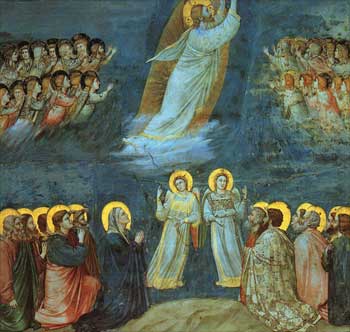
- When he had led them out to the vicinity of Bethany, he lifted up his hands and blessed them.
- While he was blessing them, he left them and was taken up into heaven.
- Then they worshiped him and returned to Jerusalem with great joy.
- And they stayed continually at the temple, praising God.”
The Book of Acts alters the story slightly, having Jesus not “taken up into heaven” on the same night as his Sunday resurrection appearance but says instead that Jesus was on earth for “forty days.” But even in the Book of Acts, the people who allegedly encountered the resurrected Jesus prior to his ascension were only said to have been “the apostles”:
Acts 1:2 “…giving instructions through the Holy Spirit to The Apostles [capitalization added for emphasis] he had chosen.
3 After his suffering, he showed himself to these men [i.e., to “the apostles” as mentioned in the previous verse] and gave many convincing proofs that he was alive. He appeared to them [i.e., referring back again to “the apostles”] over a period of forty days and spoke about the kingdom of God.
4 On one occasion, while he was eating with them [the “apostles”], he gave them this command: “Do not leave Jerusalem…
9 After he said this, he was taken up before their very eyes [before the eyes of “the apostles”], and a cloud hid him from their sight.
The implication in both Luke and Acts was that (with the rare exception mentioned in Luke, i.e., of the encounter when two people didnʼt even recognize the raised Jesus) only “the apostles” spent time with the allegedly raised Jesus and then saw him “taken up into heaven” when his “flesh and bone, fish-eating body” rose up into the sky.
So I wonder why the flesh and blood raised Jesus showed himself only to “the apostles,” while the “many raised saints” (some of whom must have been “dead” for longer than Jesus was) could “enter the holy city” and “show themselves to many?” And why was that latter tale of the “raising of the many” only found in two small verses in Matthew and not mentioned in any other Gospel, nor are the “many raised saints” mentioned in Acts, nor anywhere else in the N.T., not even when discussions of “the resurrection” arise? Something doesnʼt sound right.
As I already mentioned, the fragment from the early second century Christian apologist whom Miller cited, above, does not specifically mention the “raising of the many.” Other mentions of the “many raised saints” are only in later Christian works that evidently sought to expand upon the two non-descript verses in Matthew, and such works are not considered canonical but “apocryphal.” In fact in one such work some of the “raised saints” are named as being, “Adam, Eve, Isaiah,” etc.
Also of interest concerning this topic is that “resurrection miracles” are said to have occurred among Christians after the time of Jesus and his apostles. Brief mention of such miracles can be found in the works of the church fathers, including Augustine. However, such stories have been belittled by Protestants because the early church was “Catholic” and stories of miracles in the “Catholic church” if true, lend too much credence to that churchʼs authenticity and authority over and above that of the “Protestant churches.” Just read, for instance, how the famed Protestant theologian, B. B. Warfield, thoroughly debunked Catholic miracles and resurrection stories in his famous work, Counterfeit Miracles (London: Banner of Truth Trust, 1972). Which just goes to show, as Dr. Robert M. Price [former fundamentalist], wrote, “The zeal and ingenuity of conservative evangelical scholars in dismantling the miracles of rival Christian groups (and exploding rival interpretations of Scripture used to support such miracles), is worthy of the most skeptical gospel critic.” Along those same lines, the conservative Christian, George W. Peters, dismantled stories of “resurrections” that allegedly took place in the 1970s during the Pentecostal revival in the Philippines. (See Petersʼ book, Indonesia Revival: Focus on Timor (Grand Rapids: Zondervan, 1973), Chapter 4, “The Miracle Phenomena of the Revival,” pp. 57-85.) And conservative Christians dismantled claims made by televangelist, Benny Hinn, that he had performed many miracles, including “raising” someone to life: “Benny Hinn is prone to make wild claims. In a recent show he told the audience, ‘I was in Ghana just recently — we had half a million people show up — and a man was raised from the dead on the platform.
‘Thatʼs a fact, people. A man was raised from the dead on the platform. We have it on video.’ IMPACT asked Hinnʼs television producer, Jeff Pittman, for a copy of that video. But we were told Hinn misspoke, and the cameras werenʼt rolling at the time. When IMPACT asked Hinn about the resurrection claim, he backtracked from his original story. ‘God can raise the dead. Absolutely. I have not seen it. In that one case we did hear about it.’”
Source: Deception In The Church
For more on Hinn.
Comment by Timothy W. Grogan: Former Fundamentalist
There are many alleged raisings from the dead reported by early Christians. For example, Irenaeus in his multi-volume work Against the Heresies, stated: “Some persons that were dead have been raised again and continued among us many years.” If we believe Matthewʼs account (27:52-53) on his say so, then on what fair grounds can we dismiss the account of Irenaeus? We know a lot more about Irenaeus than about Matthew.
The point I wish to make is this:
There is no end to the number of miracles claimed by the adherents of various religions and if we admit that the very weak evidence found in the Gospels is enough to persuade a person of the reality of Jesus being raised, then we cannot escape the conclusion that other resurrections have also occurred. In order to emphasize this point, I have xeroxed off the front cover of a book Raised from the dead: true stories of 400 resurrection miracles by Father Albert J. Hebert S.M. In his book, Father Hebert claims many resurrection miracles have been performed by Roman Catholic saints. On what historical grounds can these miracles be rejected without also rejecting those found in the N.T.? If Father Hebert is correct arenʼt the miracles he enumerates proof that the Roman Catholic Church is the true church of God? The miracles Father Hebert documents happened much more recently than those that are reported in the Gospels and they are reported by people we know a lot more about than the alleged Gospel writers.
Donʼt misunderstand me, I think that these accounts are wholly legendary and I am sure you would agree. I believe that the purpose of these religious fictions was largely to encourage faith. But what do we know of the alleged writers of the Gospels that assures us that they would not use pious legends to encourage faith?
In an old, not too well known book, on the miracles reported to have taken place in the early church Dr. Conyers Middleton says regarding the early church fathers:
“I have shown by many indisputable facts, that the ancient fathers, by whose authority that delusion was originally imposed (that miracles existed in the early church - T.W.G.), and has ever since been supported, were extremely credulous and superstitious; possessed with strong prejudices and enthusiastic zeal, in favor, not only of Christianity in general, but of every particular doctrine, which a wild imagination could ingraft upon it; and scrupling no art or means, by which they might propagate the same principles. In short; they they were of a character, from which nothing could be expected, that was candid and impartial; nothing but what a weak or crafty understanding could supply, towards confirming those prejudices, with which they happened to be possessed; especially where religion was the subject, which above all other motives, strengthens every bias, and inflames every passion of the human mind.”
— Conyers Middleton (1749), A free inquiry into the miraculous powers which are supposed to have subsisted in the Christian church from the earliest ages through several successive centuries. Reprinted (1967). New York: Garland Publishing. Preface, pp. 21-22.
I ask again, if the early Christian Fathers engaged in this type of pious fraud why couldnʼt Matthew have done the same thing? How do we even know that Matthew wrote the Gospel ascribed to him — the answer The Early Church Fathers. With all due respect, these early Christians donʼt seem to be the most reliable historians. We know that some early Christians tamped with the text of the N.T. (Who added the last 12 verses of Mark, or Markʼs other late appearing alternate endings of which there are more than one?) Perhaps the traditions that they passed down to us concerning Gospel origins are also just so much pious fiction. After all, it doesnʼt really matter who wrote the books attributed to Aristotle since these are works of genius — no matter who wrote them. But it does matter who wrote the Gospels since to mean anything at all they must be written by people who witnessed the events that occurred in the life of Jesus.
In conclusion, I donʼt think there is strong documentary evidence for the resurrection of Jesus. We have anonymous Gospels and second hand stories of appearances, whose development I think Ed does a nice job accounting for. (See Edʼs questions raised in his letter with resurrection apologist Dr. Gary Habermas of Liberty University, though Dr. Priceʼs questions concerning the resurrection range far deeper, Edʼs questions are perhaps an easier place to start.) I think that an explanation based on the development of pious legends around Jesus is the most satisfying explanation currently available.
I further suggest reading an essay by T. H. Huxley that has a direct bearing on the topic at hand. I would particularly direct your attention to “The Value of Witness to the Miraculous” ending with “If the evidence of Eginhard is insufficient to lead reasonable men to believe in the miracles he relates, _a fortiori_ the evidence afforded by the Gospels and Acts must be so.”
Comment By Steve Locks: Former Fundamentalist, Creator Of The “Leaving Christianity” Website
Did you know that Jesus recently miraculously appeared before 6,000 in Nairobi? There are even photos of him and testimonies to his miraculous appearance and disappearance.
This time he went off in a car though, but then vanished without ascending. That was 1988 and theyʼre still talking about it. The movement is Christian. At least it was 6,000 Christians who were calling him “Jesus.” Although others later claimed him to be Maitreya, the crowds were calling “Jesus! Jesus! Jesus of Nazareth!”. As it says on the website 6,000 believed they saw Jesus Christ, in broad daylight. They are not the only Christians who have claimed to see Christian figures to the embarrassment of other Christians as I know you are well aware. The article was for light relief mostly, but with one serious point which I wondered if anyone would pick up on. That is the gullibility of crowds.
Comment By Pat Swindoll: Former Fundamentalist And Former Religious Right Activist
What David also misses is that the resurrection describe in Matthew occurred before Jesusʼown resurrection, thus making it theologically incompatible with the basic Christian doctrines that Christʼs was the first born of many and other Christiansʼ resurrections were made possible by Christʼs (i.e. He descended to hell and was separated from the Father for the first time since Creation itself). Given these facts, it is obvious that whoever wrote Matthew threw these representations in for the same reason he or she represented that Herod ordered the deaths of all two year old and younger boys in Israel; that Jesus rode into Jerusalem on the First Palm Sunday on two, not one donkey; that Jesusʼs step fatherʼs genealogy derives from King David even though, if Jesus were born of a virgin, Josephʼs genealogy would be irrelevant and Joseph was descended through Nathan, not Soloman as required by Messianic prophecy; that Jesus was crucified after eating the Passover with his disciples, thus making the date of his resurrection the First Day of Unleavened Bread (15 Nissan), itself a high holy day that precluded observant Jews from doing any work including participating in a trial and, in Joseph of Arimetheaʼs case taking Jesusʼ body off the cross so it wouldnʼt be there during the Seventh Day Sabbath. If it were no problem for Jesusʼ body to be on the cross on one Sabbath, why not the other?
Whoever wrote Matthew was largely ignorant of Jewish scripture and prophecy and knew only enough to get himself in trouble with anyone with even minimal knowledge of the Old Testament.
Speaking not about the “Resurrection of the Saints” but about the “Resurrection of Jesus”
The Resurrection is a controversial topic and ranges over a wide variety of opinions even amongst Christians.
There are fundies and hard line Christian religious conservatives for whom anything less than bodily resurrection is unacceptable.
There are moderates and liberals, like Anglican archbishop, Peter Carnely (author of The Structure of Resurrection Belief), who recognize that a lot of the early New Testament speaks of Jesus being exalted in heaven, and that may have been the earliest belief among Jesusʼ followers, namely that Jesus was vindicated in heaven after he died, with the idea of resurrection following soon afterwards since Hebrew culture defined the afterlife in resurrection terms, and because many even expected a general resurrection and end of the world before Jesus and his followers began preaching such things. So in what other way could they speak about Jesusʼ ultimate vindication other than in “resurrection” terms?
The earliest N.T. writing of all is generally agreed to be 1 Thessalonians, which mentions Jesus as having been exalted in heaven and coming back soon in final judgment. (And the description in Thessalonians of Jesus coming back as Godʼs appointed judge is very reminiscent of a pre-N.T. Dead Sea scroll that pictured Melchizadek performing a similar function, as Godʼs judge on the day of judgment, so the idea of a man being specially appointed as Godʼs judge was already “in the air” so to speak even before Jesusʼ day.)
The earliest N.T. reference to Jesusʼ post-resurrection “appearances” is found in 1st Corinthians in a section of that letter that some Bible scholars believe may have been a later interpolation. Robert M. Price has several articles on the web concerning that argument:
Apocryphal Apparitions: 1 Corinthians 15:3-11 as a Post-Pauline Interpolation
Miracles Part II by Robert M. Price
Hard-line Christian conservative apologist at Liberty University, Dr. Gary Habermas, defends a bodily resurrection, but Dr. Robert M. Price questions the reliability of N.T. books and stories, and questions Habermasʼ assumptions of Biblical and doctrinal infallibility/inerrancy.
Glenn Miller on Miracles by Robert M. Price
A thorough criticism on the Gospels and Glenn Morton (apologist) written by a PhD in New Testament Theology.
See also Priceʼs review of the recent book on the resurrection by moderate Christian theologian, N.T. Wright [Priceʼs review is due to appear in The Journal Of Higher Criticism. Here is a foretaste of his review]:
N.T. Wright, The Resurrection of the Son of God. Christian Origins and the Question of God Volume Three (Minneapolis: Fortress Press, 2003) xxi = 817 pp. ISBN 0-8006-2679-6. paperback $39.00. Reviewed by Robert M. Price. copyright, The Journal of Higher Criticism (not yet published in that journal, visit them online)
This massive book is an exercise in prolixity. It is several times longer than it needs to be, as if designed to bludgeon us into belief. One might save a lot of time and money by finding a copy of George Eldon Laddʼs I Believe in the Resurrection of Jesus (Eerdmans, 1975), which used most of the same arguments at a fraction of the length, and without skimping. The arguments have not gotten any better. They are the same old stale fundamentalist apologetics we got in Ladd, essentially the same old stuff we used to read in Josh McDowell and John Warwick Montgomery. The same hash reslung. Only now it is getting pretty smelly. Perhaps that is why Wright seeks to perfume it, reminiscent of Joseph and Nicodemus attempting to fumigate the decaying corpse of Jesus by encasing it in an extravagant hundred pounds weight of spices (John 19:39). Wright backs up much too far to make a running start at the resurrection, regaling us with unoriginal, superfluous, and tedious exposition of Old Testament and Intertestamental Jewish ideas of afterlife and resurrection, resurrection belief in every known Christian writer up into the early third century, etc., etc. The mountain thus laboring is doomed to bring forth a messianic mouse, alas. All this erudition is perhaps intended to intimidate the reader into accepting Wrightʼs evangelistic pitch. But it is just a lot of fast talking. In the end, Wright, now Bishop of Durham, is just Josh McDowell in a better suit. His smirking smugness is everywhere evident, especially in his condescension toward the great critics and critical methods of the last two centuries, all of which he strives to counteract. He would lead the hapless seminary student (whom one fears will be assigned this doorstop) backwards into the pre-critical era with empty pretenses of post-modern sophistication, shrugging off the Enlightenment by patently insincere attempts to wrap himself in the flag of post-colonialism. Genuine criticism of the gospels he dismisses as the less advanced, muddled thinking of a previous generation, as if “cutting edge” scholarship like his were not actually pathetic nostalgia for the sparkling Toyland of fundamentalist supernaturalism. It is a familiar bag of tricks, and that is all it is. The tragedy is that many today are falling for it. Witness Wrightʼs own prominence in the Society of Biblical Literature, to say nothing of his ecclesiastical clout. The weight of this bookʼs argument for orthodox traditionalism is to be found, of all places, in the acknowledgements section, where Wright thanks the hosts of the prestigious venues where he first presented bits of this material: Yale Divinity School, South-Western Theological Seminary, Duke Divinity School, Pontifical Gregorian University, St. Michaelʼs Seminary, etc., etc. Wright is the mouthpiece for institutional orthodoxy, a grinning spin-doctor for the Grand Inquisitor. What credibility his book appears to have is due to the imposing wealth, power, tradition, even architecture, of the social-ecclesiastical world which he serves as chaplain and apologist. It is sickening to read his phony affirmations of the allegedly political and radical import of a literal resurrection (if you can even tell what Wright means by this last). Does Bishop Wright espouse some form of Liberation Theology? No, for, just as he emptily says Jesus redefined messiahship, Wright redefines politics. When he says the early Christians were anti-imperialistic, all he has in mind is the fact that Christians withstood Roman persecution, valiant enough in its way, but hardly the same thing. Like a pathetic Civil War re-enactment geek, he is sparring at an enemy safely dead for centuries. In attempting to co-opt and parody the rhetoric of his ideological foes, Wright reminds me of Francis Schaeffer, a hidebound fundamentalist who began as a childrenʼs evangelist working for Carl MacIntyre. Schaeffer, posing as an intellectual and a philosopher, used to stamp the floor speaking at fundamentalist colleges, shouting “We are the true Bolsheviks!” Right. Part of Wrightʼs agenda of harmonizing and de-fusing the evidence is to smother individual New Testament texts beneath a mass of theological synthesis derived from the Old Testament and from the outlines of Pauline theology in general. He is a victim of what James Barr long ago called the “Kittel mentality,” referring to the approach of Kittelʼs Theological Dictionary of the New Testament, in which articles on individual New Testament terms and words synthesized from all uses of the term an artificial and systematic semantic structure, leading the reader to suppose that every individual usage of the word was an iceberg tip carrying with it implied reference to all other references. In other words, each article in the TDNT composed a “New Testament theology,” topic by topic. In just this manner, Wright first composes a streamlined Old Testament theology of historical and eschatological redemption (akin to that of Von Rad, without the latterʼs understanding that much of it was based on fictive saga rather than history); then Wright synthesizes a Pauline Theology, then a New Testament theology, then an early Christian theology; and finally he insists that the synthetic resurrection concept he has distilled must control our reading of all individual gospel and Pauline texts dealing with the resurrection. In short, it is an elaborate exercise in harmonizing disparate data. The implications of 1 Corinthians 15, for example, with its talk of spiritual resurrection, are silenced as the text is muzzled, forbidden to say anything outside the party line Wright has constructed as “the biblical” teaching on the subject. Another example is his insistence on translating the Greek “Christos” as “the Messiah” in Pauline passages, lending them a falsely Jewish coloring belied by their content. Wright even admits that the Pauline writings are already pretty much using “Christ” as simply another name for Jesus, yet he wants to tie Paulʼs theology in with the grand arc of Old Testament theology, “redemptive history,” or whatever. Similarly, he sees everything in the context of second-temple Judaism. Again, we detect here a phony ecumenism, as if he thought Jews were not all going to hell for rejecting Jesus as the Son of God.
The same is true with his cosmetic use of politically correct inclusive language and ecumenical mistranslations of “Jews” as “Judeans,” etc. It is all to butter up the reader, like a used-gospel salesman closing in for the sale. Wright is a better-educated Anglican Zig Zigler. In reality, the only value he sees in Judaism is the safe haven it gives him from taking into account the patent influence on early Christianity of Hellenistic Mystery religions, which are really all we need to account for the empty tomb legend and the resurrection myth. For Wright “Judaism” really denotes Old Testament and rabbinic interpretation of it. Here we spot the reason for, and the character of, the unholy alliance between mainstream Judaism and Evangelical Protestantism in the pages of the Journal of Biblical Literature and Bible Review. They are closing ranks against radical critics in both traditions: Old Testament minimalists and Jesus Seminar-type scholars alike. It is rather like the Moral Majority, uneasy allies with certain goals in common. There are three fundamental, vitiating errors running like fault lines through the unstable continent of this book. The first is a complete unwillingness to engage a number of specific questions or bodies of evidence that threaten to shatter Wrightʼs over-optimistically orthodox assessment of the evidence. The most striking of these blustering evasions has to do with the dying-and-rising redeemer cults that permeated the environment of early Christianity and had for many, many centuries. Ezekiel 8:14 bemoans the ancient Jerusalemite womenʼs lamentation for Tammuz, derived from the Dumuzi cult of ancient Mesopotamia. Ugaritic texts make it plain that Baalʼs death and resurrection and subsequent enthronement at the side of his Father El went back centuries before Christianity and were widespread in Israel. Pyramid texts tell us that Osirisʼ devotees expected to share in his resurrection. Marduk, too, rose from the dead. And then there is the Phrygian Attis, the Syrian Adonis. The harmonistic efforts of Bruce Metzger, Edwin Yamauchi, Ron Sider, Jonathan Z. Smith and others have been completely futile, utterly failing either to deconstruct the dying-and-rising god mytheme (as Smith vainly tries to do) or to claim that the Mysteries borrowed their resurrected savior myths and rituals from Christianity. If that were so, why on earth did early apologists admit that the pagan versions were earlier, invented as counterfeits before the fact by Satan? Such myths and rites were well known to Jews and Galileans, not to mention Ephesians, Corinthians, etc., for many centuries. But all this Wright merely brushes off, as if it has long been discredited. He merely refers us to other books. It is all part of his bluff: “Oh, no one takes that seriously anymore! Really, itʼs so passé!”
Wright comes near to resting the whole weight of his case on the mistaken contention that the notion of a single individual rising from the dead in advance of the general resurrection at the end of the age was unheard of, and that therefore it must have arisen as the result of the stubborn fact of it having occurred one day, Easter Day. This is basically absurd for reasons we will attend to in a moment, but the premise is false. Even leaving out the resurrections of the savior gods, Wright even mentions that the resurrection of Alcestis by Hercules is an exception to the rule, but he seems to think it unimportant. Worse, though, is his utter failure to take seriously the astonishing comment of Herod in Mark 6:14-16 to the effect that Jesus was thought to be John the Baptist already raised from the dead! Can Wright really be oblivious of how this one text torpedoes the hull of his argument? His evasions are so pathetic as to suggest he is being disingenuous, hoping the reader will not notice. The disciples of Jesus, who was slain by a tyrant, may simply have borrowed the resurrection faith of the Baptistʼs disciples who posited such a vindication for their own master who had met the same fate. Wright should really be arguing for the resurrection of John the Baptist, if it being unprecedented means anything!
Equally outrageous is Wrightʼs contrived and harmonistic treatment of the statements about a spiritual resurrection in 1 Corinthians 15, where we read that “flesh and blood cannot inherit the kingdom of God” (v. 50) and that the resurrected Jesus, the precedent for believers, accordingly possessed a “spiritual body” (v. 44). Wright labors mightily and futilely to persuade us that all Paul meant by “flesh and blood” was “mortal and corruptible,” not “made of flesh and blood.” Who but a fellow apologist (like William Lane Craig who sells the same merchandise) will agree to this? What does Wright suppose led the writer to use a phrase like “flesh and blood” for mortal corruptibility in the first place if it is not physical fleshiness that issues inevitably in mortal corruption? How can the Corinthians writer have used such a phrase if he meanwhile believed the risen Jesus still had flesh and blood? It is no use to protest that none of the “second temple Jewish” writers we know of had such a notion of resurrection. This supposed fact (and Ladd knew better: he cited apocalypses that have the dead rise in angelic form, or in the flesh which is then transformed into angelic stuff) cannot prevent us from noticing that 1 Corinthians 15:45 has the risen Christ “become a life-giving spirit.”
Likewise, when he gets to Luke, Wright laughs off the screaming contradiction between Luke 24:40 (“Touch me and see: no spirit has flesh as you can see I have.”) and 1 Corinthians 15:50 and 45 (“Flesh and blood cannot inherit the kingdom of God.” “The last Adam became a life-giving spirit.”). The contexts of both passages make it quite clear that the terms are being used in the same senses, only that one makes the risen Jesus fleshly, while the other says the opposite. Wrightʼs laughable hair-splitting is a prime example of the lengths he will go to get out of a tight spot. Similarly, when he gets to 1 Peter 3:18 (Jesus was “put to death in the flesh but made alive in the spirit, in which he went and made proclamation to the spirits in prison, etc.”), Wright rewrites the text to make it say what he wants: “he was put to death by the flesh, and brought to life by the Spirit.” This is just ridiculous. It is the exegesis of that faith that calls things that are not as though they were. Wrightʼs second mortal sin is his desire to have his Eucharistic wafer and eat it too. He takes refuge in either side of an ambiguity when it suits him, hopping back and forth from one foot to the other, and hoping the reader will not notice. For instance, Wright is desperate to break down the “flesh/spirit” dichotomy in Paul and Luke (not to mention that between Paul and Luke!), but he builds the same wall higher outside the texts. That is, he wants to say “resurrection” always meant bodily, not merely spiritual, resurrection. The latter would mean just “going to heaven,” and that will not do. But Wright confesses he has no clear idea of what sort of physical presence the risen Jesus might have had. He calls it “transphysical” and admits he cannot define it. What then is he arguing? He just knows he wants a bodily resurrection, but it has to be a body capable of passing through locked doors and teleporting, appearing and disappearing at will. Yet he despises the notion that the risen Jesus was docetic, a spiritual entity that could take on the false semblance of physicality. Wright doesnʼt want any early Christians to have believed this. He doesnʼt want it even to have existed as an heretical option that the evangelists were trying to refute! Because that would mean that a spiritual resurrection was one form of early Christian belief, which Wright is trying to rule out. Most scholars rightly see the business about the risen Jesus requesting a fish sandwich (Luke ) as demonstrating, against Gnostic docetists, that Jesus had a fleshly body. But Wright will have none of this. He is right to point out, as A.J.M. Wedderburn does in Beyond Resurrection (1999), that anti-docetism is inconsistent with the same narrativesʼ depicting Jesus walking through locked doors like Jacob Marley. But why cannot Wright see this simply attests the inconsistent piecemeal nature of the redactional attempts to “anti-docetize” the very same narratives? But Wright is stuck with both contradictory features as “eye-witness testimony” or “early tradition” which he seems to think mean the same thing. So his “transphysical” Jesus must be the equivalent to a comic book superhero like the Vision or the Martian Manhunter, possessing a physical body but able to vary physical density at will. But wait a minute. if this is not docetism, what does docetism mean? The third strike against Wright is by far the most important. He loathes Enlightenment modernity because it will not let him believe in miracles. So he must change the rules of the game. Like all apologist swindlers, Wright makes a fundamental confusion. He thinks it an arbitrary philosophical bias that historiography should be “methodologically atheistic.” Why not admit that miracles might have occurred? It may be that a miracle turns out to be the most simple and economical explanation of the data. If we are unalterably opposed to that possibility, Wright says, we are bigots and arbitrary dogmatists. Freud would readily peg Wright as a victim of reaction formation. Long ago, the Ionian philosopher Thales understood that it explains nothing if we piously say that it rains because Zeus turned the faucet on. No, even if there is a God, it is to short circuit the process of scientific explanation to invoke divine fiat. The same point is made in the cartoon where a lab-coated scientist is expounding his theory with a chalkboard full of figures. He points his pencil to a gap in the long equation and says, “Right here a miracle occurs.” It is funny for a reason Wright apparently does not understand. To say that the rise of Christian resurrection faith requires a divine intervention is tantamount to saying we just do not know how it arose. One resorts to such tactics of desperation when all else fails, as Wright thinks mundane explanations have failed. But in that moment one has not found an alternate explanation at all. It is like the fundamentalists who say God must have ignited the Big Bang since scientists cannot yet account for what chain of causation led to it. How is “God” an explanation, even if there is a God? God is a mystery, unless one is an idolater. And to claim one has “explained” a problem by invoking a mystery is no advance at all. You are trying to invoke a bigger enigma to explain a smaller one. “I have the answer to X! The answer is XX!” Erudite Bishop Wright reveals himself to be on the same level with evangelical cartoonist Jack Chick who “explains” that the unknown Strong Nuclear Force is really Jesus Christ because scripture says “in him all things hold together” (Col. 1:17). Whatʼs the difference? The instant one invokes the wildcard of divine miracles, the game of science and scientific history comes to a sudden halt. But then that is just what Wright, unsuccessfully disguising himself as a humble historian, wants to do. The good bishop would reassure the faithful that superstition is really science, harmonization is criticism, fideism is evidence.
And why does Wright think a miracle is necessary? Only a real space-time resurrection, he insists, can account for the birth and spread of resurrection faith. Of course there are many viable explanations, not least Festingerʼs theory of cognitive dissonance reduction, whereby more than one disappointed sect has turned defeat into zeal by means of face-saving denial. Wright suicidally mentions this theory, only to dismiss it, as usual, with no serious attempt at refutation. So totally does his predisposition to orthodox faith blind him that he cannot see how lame a gesture he makes. No argument against his faith can penetrate his will to believe. Every argument against his evangelical orthodoxy seems ipso facto futile simply because he cannot bring himself to take it seriously.
But suppose a miracle were required. What sort of a miracle might it be?
Wright maintains that the earliest evangelists must have been galvanized, electrified, by something mighty convincing! Set aside the fact that all manner of supposed eyewitness enthusiasts, not least UFO abductees, have equal and equally sincere zeal. This is not nearly enough; Wright needs to account for the spread of this improbable-seeming belief among those who had not themselves seen the risen Christ, if he thinks the spread of the faith requires a miracle. He himself is at pains to show how resurrection seemed absurd and distasteful to nearly everyone. If that were so, and I am not convinced it was, what Wright needs to posit is something like the Calvinist notion of the effectual call, a supernatural mesmerism whereby God makes the gospel attractive to sinners. The miracle is needed at a later stage if it is necessary at all, not that I think it is.
Wright (though by this time one is tempted to start calling him “Wrong”) uses sneer quotes, dismissing with no argument at all Crossanʼs claim (which I deem undoubtedly and even obviously correct) that the empty tomb traditions stem from womenʼs lament traditions like those mentioned in Ezekiel 8 and attested for the Osiris cult and others. Having ignored rather than refuted this contention, Wright insists that the empty tomb narratives are eyewitness evidence, evidence that is all the stronger for the supposed fact that ancient Jews did not admit legal testimony from women. Howʼs that? Wrightʼs early evangelical Anglican Christians in togas just felt they had no choice but to include this vital eyewitness testimony even though it would surely invite ridicule by Celsus and his ilk. They were stuck with it. But why? Wright himself imagines that the framers of the 1 Corinthians 15 list of resurrection appearances knew the empty tomb tale but omitted it so as not to invite ridicule. It was thinkable to do so. But the unwitting logic of Wrightʼs whole argument presses ineluctably toward saying that the empty tomb story is not even supposed to be evidence and is not offered as such. It must be there for an entirely different reason. Crossan had it right. He made sense of it. Wright doesnʼt, because he does not want anything to link the Easter story to the Mystery Religions.
Wrightʼs insistence on limiting himself to the canonical Judeo-Christian continuity blinds him to other crucial parallels to the Easter stories. The Emmaus story is cut from the same cloth as numerous ancient “angels unawares” myths, but it bears a striking resemblance to a demonstrably earlier Asclepius story where a couple returns home dejectedly after failing to receive the desired healing miracle at Epidauros. They are intercepted by a curious and concerned stranger, the divine savior incognito, who ferrets out the reason for their sadness, reveals himself, performs the hoped-for healing after all, then vanishes. The miraculous catch of fish in John 21 is patently based on an earlier Pythagoras story in which the no-longer relevant detail of the number of the fish made some sense. As Charles L. Talbert pointed out years ago (What Is a Gospel? 1977), the abrupt ending of Mark (as it seems to readers familiar with the other gospels) fits quite naturally as a typical apotheosis story, where the absence of the body combined with a heavenly voice is sufficient to attest the heroʼs exaltation to heaven. Talbert showed how an empty tomb story made sense by itself, and how the gospel tomb scene may have originated as window-dressing for an apotheosis narrative. We are not stuck with the empty tomb as a stubborn historical fact as Wright would like us to think.
These Hellenistic parallels tell us that we hardly require eyewitness testimony of miracles to explain the origin of the gospel Easter stories. Occamʼs Razor makes that altogether unnecessary. But they also explain something else Wright thinks explicable only by miracles: the absence of scriptural allusions in these stories. Wright throws down the gauntlet to Crossan, who says that the gospel Passion Narratives are historicized prophecies from the Old Testament, rewritten as New Testament stories. Why, then, is there so little scripture reflected in the burial and Easter stories? Well, there is a good bit. Matthew has supplemented Mark with Daniel, as Randel Helms shows in Gospel Fictions (1988)-and as Wright himself eventually admits! But Crossan has also shown how similar Markʼs burial and resurrection stories are to the entombment alive and subsequent crucifixion of the enemy kings in Joshua 10:16-27. Helms also shows how John 20:17 is based on Tobit 12:16-21. But there is a good bit of the gospel story that is not derived from scripture-and that is because it comes from pagan mythology and novels where prematurely entombed heroines are inadvertently rescued by tomb robbers and heroes survive crucifixion (another body of highly relevant textual evidence that Wright haughtily laughs off).
Wright piously tells us that, faced with the resurrection narratives, we ought to bow in awe and wonder. That may or may not be so, but we must blink in astonishment at Wrightʼs comments upon them! In another case of his “both/and” harmonizations (one found frequently with Evangelical scholars, i.e., apologists) Wright both claims that the resurrection narratives lack artifice (hence must be authentic “raw footage”) and that they have been thoroughly worked over by each evangelist so as to function as consistent extensions of themes and even narrative structures running through each gospel. This sort of analysis, demonstrating the thorough permeation of Markʼs Passion story by themes ubiquitous throughout the previous chapters led the contributors to Werner H. Kelberʼs symposium The Passion in Mark (1976) to conclude that Mark had no preexistent passion tradition but composed the whole thing. Such an obvious conclusion never occurs to Wright. For him, each narrative is both early unadorned tradition and thoroughly modified. It is either one as he needs it to be. He throws source criticism out the window when he needs to, claiming, astonishingly, that there is so little apparent interdependence between the tomb tales of Mark, Matthew, and Luke that we cannot be sure they are not independent tellings of the same story, learned by each evangelist via different channels. This is a way of discounting the great degree to which Luke and Matthew have rewritten Mark, maintaining they are all separate collectors of “early traditions,” a slippery repristination of the old Sunday School notion that the four evangelists are independent witnesses, as if to the same auto accident. Again, there is no stale crust of apologetical sleight-of-hand that Wright will not claim as a “critical advance” upon Enlightenment scholarship.
For Wright, Matthewʼs accuracy is demonstrated by the fact that he seems to have added no new stories to the resurrection plot-line. What about the repeated earthquakes, the descent of the angel, the guards at the tomb, the embassy of the Sanhedrin to Pilate, the rising of the dead saints on Good Friday? Without a word as to the improbability of other evangelists omitting it if it had happened, Wright confesses himself ready to swallow the historical accuracy of the guards. Wright thinks it makes sound sense that the guards are to tell that the disciples stole the body while the guards were asleep? How did they know what happened while they were snoozing? Wright seems not to recognize comedy if there is no laugh track. Wright insists that the gospel writers must have believed in a literal resurrection (whatever that would be: Jesus becoming the Martian Manhunter again?). But can we be so sure of that, given certain elements of their narratives? Lukeʼs Emmaus scene is transparently symbolic of the invisible presence of Christ among his followers every Sunday at the breaking of the bread. (Wright finally admits this, but he insists that it also really happened, more of his both/and-ism.) Matthew ends not with an ascension to get Jesus off the stage of history (as in Acts), but with Jesus assuring the readers (at whom the Great Commission must be aimed) that he will continue with them until the end of the age. Does this not imply that the resurrection was after all the inauguration of the metaphorical/spiritual sense in which Matthewʼs readers, like modern Christians, sense Jesus intangibly with them? Johnʼs story of Doubting Thomas concludes with Jesus making an overt aside to the reader: “Blessed are those who have not seen yet have believed.” Can this writer have seriously intended his readers to think they were reading history? Such asides to the audience are a blatant and overt sign of the fictive character of the whole enterprise. As Barr pointed out long ago (Fundamentalism, 1977), the fact that Luke has the ascension occur on Easter evening in Luke 24 but forty days later in Acts chapter 1 (something Wright thinks utterly insignificant!) shows about as clearly as one could ask that Luke was not even trying to relate “the facts” and didnʼt expect the reader to think so.
One could easily go on and on and on, even as Wright does, and because Wright does. What we have in this book is not a contribution to New Testament scholarship, any more than Creationist “Intelligent Design” screeds are contributions to biological science. Both alike are pseudo-scholarly attempts to pull the wool over the eyes of readers, most of whom will be happy enough for the sedation.
Dr. Robert M. Price has two Ph.D.s, one in N.T. theology, and the other in N.T. history, and he is coming out with a book of essays on the resurrection question, co-edited with Jeffrey J. Lowder, which will be published by Prometheus Books, titled, Jesus Is Dead. Priceʼs other works from Prometheus include, Deconstructing Jesus [a detailed discussion of questions concerning Christian origins raised by members of the Jesus Seminar], and, The Incredible Shrinking Son Of Man [a work more geared toward the general reading public, as was Priceʼs much earlier online book, Beyond Born Again].
See also… Peter Kirby, the creator of several useful theological information websites: Early Christian Writings